 Pre
Marriage/Spouse selction/Proposals Duas & Islamic Etiquettes
Pre
Marriage/Spouse selction/Proposals Duas & Islamic EtiquettesPre
Marriage/Spouse selction/Proposals Duas & Islamic Etiquettes
A two rak'at prayer that a married person establishes is worthier than when a bachelor keeps up prayers at nights and fasts during the days.
The Holy Prophet [saw], Man La Yahduruhul Faqih, vol. 3, p. 384
Duas /Recitations to get Married Special for daughters
In case a boy or a girl has not been able to get married & wishes to do so ,Recite foll :-
-Recite Surah al Ahzaab (chapter 33) regularly. -Recite Surah al Mumtahinah (chapter 60) five times daily,
-Recite surah at Taha (chapter 20) and blow breath on a glass of water and let the girl drink it.-Sura-e-Muzammil each day once for 41 days & pray for it REF: Wazaif-ut-talib, pg no. 76.
-Recite verse 36 of Yasin 100 times before salat of tahajjud for 40 days "subh'aanallad'ee khalaqal azwaaja kullahaa mimmaa tumbitul arz'u wa min anfusihim wa mimmaa laa ya'lamoon, " سُبْحَانَ الَّذِي خَلَقَ الْأَزْوَاجَ كُلَّهَا مِمَّا تُنبِتُ الْأَرْضُ وَمِنْ أَنفُسِهِمْ وَمِمَّا لَا يَعْلَمُونَ ﴿٣٦﴾
-Recite Surah Furqan Ayat 74,75 & 76 21 times for 3 days & pray for nikah
-Recite Surah Tariq Ch 86 3 times esp on Arafat day during hajj on plains of Arafah,ask someone going ,or do this daily from home
-It is written in Biharul Anwar that to invoke the almighty Allah that a grown up boy or a girl be suitably married carry out the following a'mal of du-a'a of Mashlul
(i) Recite du-a'a al Mashlul preferably after Fajr salat or any obligatory salat for 40 consecutive days.
(ii) Do not eat animal flesh
(iii) Always remain the state of Ablution
(iv) Wear Ihram dress at the time of reciting the du-a'a
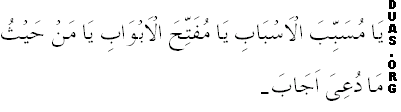
Dua'a 181 Recite the following du-a'a after giving sadaqa to deserving mumin .
|
�O Causer of the Causes; O He who opens the doors (to opportunities); O� He who gives an answer to the call from wherever (He is called).� Yaa Musabbibal Asbaabi Yaa Mufattihal Abwaabi Yaa Man Haythu Maa Du-ee-Ya Ajaaba |
|
-Dua'a 182 According to Biharul Anwar to invoke the almighty Allah that a grown up boy or girl be suitably married recite the following du-a'a 100 times daily for 40 consecutive days after any obligatory salat.
|
�Make easy (my difficulties), by Your superabundant favours, O� the Most Mighty.� Sahlam Bi Fadhlika Yaa `Azeez |
|
-Dua'a 183 It is written in Bihar al Anwar that if a grown up girl is not receiving any offer of marriage, her father should pray a 2 rak-at salat (like Fajr salat) on Friday after Jumu-ah prayers and after the salam go into Sajdah and recite surah al Muzzammil (chapter 73) 21 times. Inshallah very soon she will be married to a suitable man.
Dua'a 184 It is written in Biharul Anwar to write the following portion of verse 132 of at Ta Ha on a paper with the solution of musk, saffron and rose water and bind it as a Ta'wid on the right arm, if a man desires to be married soon. Bind another Ta'wid like above on the right arm of the man or woman who is negotiating the proposal of marriage.
|
�It is We who give you sustenance, and the good of the hereafter is for those who have Allah consciousness and guard themselves against evil.� Nahnu Narzuquka wal `Aaqibatu Lit-Taqwa |
|
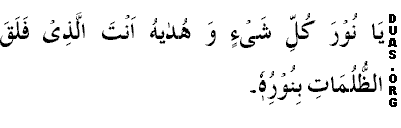
-Dua'a 185 It is written in Kanzul Maknun to write the following du-a'a on a paper like a Ta'wid and bind it on the right arm of the grown up girl who is not receiving any offer of marriage. Inshallah, soon she will be married. As there is ismi a'z'am in this du-a'a, it should be removed during menses.
|
O Light of everything which guides them, You are He who cuts asunder darkness with His light. yaa noora kulli shay-in wa hudaahu antallad'ee falaqaz' z'ulumaati binooruhoo |
 |
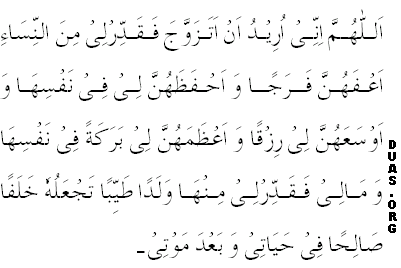
Dua'a 186 Matrimonial affairs proposal of Marriage According to Imam Jafar bin Muhammad as Sadiq(as), it is written in Biharul Anwar, whoever desires to marry should recite the following du-a'a before making a formal request for marriage.
اَللّٰهُمَّ اِنِّيْ اُرِيْدُ اَنْ اَتَزَوَّجَ فَقَدِّرْ لِيْ مِنَ النِّسَآءِ اَعْفِهُنَّ فَرْجًا وَ احْفَظِهُنَّ لِيْ فِيْ نَفْسِهَا وَ اَوْسِعْهُنَّ لِيْ رِزْقًا وَاَعْظَمِهُنَّ لِيْ بَرَكَةً فِيْ نَفْسِهَا وَ مَا لِيْ فَقَدِّرْ لِيْ مِنْهَا وَلَدًا طَيِّبًا تَجْعَلُهٗ خَلَفًا صَالِحًا فِيْ حَيَاتِيْ وَ بَعْدَمَوْتِي
|
�O� Allah! I desire to marry, so arrange for me a woman from those who willingly abstain from what is unlawful and who safeguards her soul for my sake and because of her, not only my means of sustenance will increase, but also make there be in it abundance and also make it sure that she will give me a virtuous son, who will be a noble successor in my life and after my death.� Allahumma Innee Urreedu An Atazawwaja Faqaddir Lee Minan Nisaa-I A�fihunna Farjajan wa Ah�fadh�ihunna Lee Fee Nafsihaa Wa Awsa-i-Hunna Lee Rizwan Wa A-dhamahunna Lee Barakatan Fee Nafsihaa Wa Maaleee Faqaddir Lee Minhaa Waladan Tayyiban Tajaluhoo Khalafan Saalihan Fee Hayaatee Wa Ba`da Mawtee. |
|
Dua'a 187
-It is written in Behaarul Anwaar that if unmanageable impediments are obstructing your marriage write the following verses (Taahaa: 131, 132) with saffron and keep it on the body. Inshallah all hindrances will disappear.
وَلاَ تَمُدَّنَّ عَيْنَيْكَ اِلٰى مَا مَتَّعْنَا بِهٖ اَزْوَاجًا مِّنْهُمْ زَهْرَةَ الْحَيٰوةِ الدُّنْيَا، لِنَفْتِنَهُمْ فِيْهِ، وَرِزْقُ رَبِّكَ خَيْرٌ وَّ اَبْقٰى. وَاْمُرْ اَهْلَكَ بِالصَّلٰوةِ وَاصْطَبِرْ عَلَيْهَا، لاَ نَسْئَلُكَ رِزْقًا، نَحْنُ نَرْزُقُكَ، وَالْعَاقِبَةُ لِلتَّقْوٰى.
wa laa tamuddanna a�ynayka elaa maa matta�naa behi azwaajam minhum zahratal hayaatid dunyaa, le naftenahum feehe, wa rizqo rabbeka khayruwn wa abqaa. waamur ahlaka bis-salaate was�t�abir a�layhaa laa nas-aloka rizqaa nah�no narzoqok wal a�aqebato littaqwaa.
Do not strain your eyes towards that which we have given for enjoyment to parties (wedded pairs) of them, the splendor of the life of this world, so that we may try them in it. The provision of your lord is better and more lasting. Enjoin prayer (salat) on your followers, and adhere steadily to it, we do not ask you to provide (subsistence), (it is) We who give you subsistence; and (the good of) the hereafter is for those who safeguard themselves against evil with full awareness of divine laws.]
188 -To get your Daughter married in a good family the following A�amal is recommended
i) Recite two rak-at salat with the niyat of hajaat.
ii) Then recite 11 times salawat.
iii) Then recite the five tasbih of Sayyida Fatima Zehra as under :
ALLAAHU AKBAR 34 Times ALHAMDULILLAH 34 Times SUBHANALLAH 33 Times LAA ILAHA ILLALLAH Once
iv) Recite 11 times salawat.
v) Then recite the following Surahs consequently: Taha (#20), Shu-ara (#26), Naml (#27), Qasas (#28), Ya Sin (#36) & Shura (#42).
Beseech Allah swt with intercession of the 14 Masumin (a.s.) and the marriage relationship of Imam Ali (a.s.) and Sayyida Fatima (a.s.) and pray for the girls of our community and then your own daughter(s).
Recite Sura 19 Maryam daily Girl herself should recite or mother
Chapter of ease in marriage of daughter/s ( Source Tohfatul Hashmiya)
It is narrated from Imam Ja�far as-Sadiq (a.s.) that he said: One who has an unmarried daughter in the house should write Surah Ahzab on deerskin and keep it in a container and close the lid tightly in the house where she lives. Very soon a groom would be found for her by the leave of Allah.
Also mentioned for the marriage of daughter; It is that the Surah Shura be written with كهيعص on a white clear paper by musk, saffron and rose water. Wash it with water and sprinkle it upon the head of the daughter whose marriage is intended and the aim shall be achieved by way of ease in the marriage by the leave of Allah.
For one who intends to marry and does not want his request rejected; It is narrated from the Holy Prophet (s.a.w.s.) that he said: One who writes seven verses and puts it on a green cloth and sends it to people he will not be rejected, his intention shall be fulfilled by the permission of Allah.
Chapter on ease in marriage of daughter ;It is that you write the holy verses by musk, saffron and rose water from the beginning of Surah Fath till the seventh verse on the dress of the unmarried girl that she wears and the following are to be written:
إِنَّا فَتَحْنَا لَكَ فَتْحًا مُّبِيْنًا. لِيَغْفِرَ لَكَ اللهُ مَا تَقَدَّمَ مِنْ ذَنْبِكَ وَ مَا تَأَخَّرَ وَ يُتِمَّ نِعْمَتَهُ عَلَيْكَ وَ يَهْدِيَكَ صِرَاطًا مُّسْتَقِيمًا. وَ يَنصُرَكَ اللهُ نَصْرًا عَزِيْزًا. هُوَ الَّذِيْ أَنْزَلَ السَّكِينَةَ فِيْ قُلُوْبِ الْمُؤْمِنِيْنَ لِيَزْدَادُوْا إِيْمَانًا مَّعَ إِيْمَانِهِمْ وَ ِللهِ جُنُوْدُ السَّمَاوَاتِ وَاْلأَرْضِ وَ كَانَ اللهُ عَلِيْمًا حَكِيْمًا. لِيُدْخِلَ الْمُؤْمِنِيْنَ وَ الْمُؤْمِنَاتِ جَنَّاتٍ تَجْرِيْ مِنْ تَحْتِهَا اْلأَنْهَارُ خَالِدِيْنَ فِيْهَا وَ يُكَفِّرَ عَنْهُمْ سَيِّئَاتِهِمْ وَ كَانَ ذٰلِكَ عِنْدَ اللهِ فَوْزًا عَظِيْمًا. وَ يُعَذِّبَ الْمُنَافِقِيْنَ وَ الْمُنَافِقَاتِ وَ الْمُشْرِكِيْنَ وَ الْمُشْرِكَاتِ الظَّانِّيْنَ بِاللهِ ظَنَّ السَّوْءِ عَلَيْهِمْ دَائِرَةُ السَّوْءِ وَ غَضِبَ اللهُ عَلَيْهِمْ وَ لَعَنَهُمْ وَ أَعَدَّ لَهُمْ جَهَنَّمَ وَ سَائَتْ مَصِيْرًا. وَ ِللهِ جُنُوْدُ السَّمَاوَاتِ وَ اْلأَرْضِ وَ كَانَ اللهُ عَزِيْزًا حَكِيْمًا.
Innaa fatah�nalaka fat�ham mubeenaa. Liyaghfira lakallaahu maa taqaddama min dhambika wa maa ta-akhkhara wa yutimma ni�matahu a�laika wa yahdiyaka s�iraatam mustaqeemaa. Wa yans�urakallaahu nas�ran azeezaa. Huwalladhee anzalas sakeenata fee quloobil mu-mineena liyazdaadu eemaanam ma-a� eemaanihim wa lillaahi junoodus samaawaati wal arz�i, wa kaanallaahu a�leeman h�akeemaa. Liyudkhilal mu-mineena wal mu-minaati jannaatin tajreemin tah�tihal anhaaru khaalideena feehaa wa yukaffir a�nhum sayyi-aatihim, wa kaana dhaalika i�ndallaahi fauzan a�z�eemaa. Wa yua�dhdhibal munafiqeena wal munaafiqaati wal mushrikeen wal mushrikaatiz� z�aaanneena billaahi z�annas sau-i, a�laihim daa-iratus sau-i wa ghaz�iballaahu a�laihim wa la�nahum wa aa�ddalahum jahannama wa saa-at mas�eeraa. Wa lillaahi junoodus samaawaati wal arz�i, wa kaanallaahu a�zeezan h�akeema.
Surely We have given to you a clear victory. That Allah may forgive your community their past faults and those to follow and complete His favor to you and keep you on a right way. And that Allah might help you with a mighty help. He it is Who sent down tranquility into the hearts of the believers that they might have more of faith added to their faith and Allah�s are the hosts of the heavens and the earth, and Allah is Knowing, Wise. That He may cause the believing men and the believing women to enter gardens beneath which rivers flow to abide therein and remove from them their evil; and that is a grand achievement with Allah. And (that) He may punish the hypocritical men and the hypocritical women, and the polytheistic men and the polytheistic women, the entertainers of evil thoughts about Allah. On them is the evil turn, and Allah is wroth with them and has cursed them and prepared hell for them, and evil is the resort. And Allah�s are the hosts of the heavens and the earth; and Allah is Mighty, Wise. [1]
She would soon be married by the leave of Allah, the Exalted.
On the good fortune for the daughters ;
One who intends success and good fortune for his daughter, should give in Sadaqah (Charity) some dates for the sake of Allah, the Exalted, in the same way: He should calculate her age and for each year he should take twelve dates. If her age is 20 years then he should give 240 dates and it is necessary that he should recite Surah Fath, Surah Yasin and Surah Nasr on the dates. He would indeed achieve his aim by the power of Allah.
For fulfilling ones intention one should write the following supplication and tie it up in the hair of the daughter for forty days:[2]
وَ مِنْ كُلِّ شَیْءٍ خَلَقْنَا زَوْجَيْنِ لَعَلَّكُمْ تَذَكَّرُوْنَ. اَللَّهُمَّ بِحَقِّ قَوْلِكَ هٰذَا وَ بِحَقِّ مُحَمَّدٍ وَ عَلِىٍّ اَنْ تَرْزُقَ هٰذِهِ الْمَرَاةِ زَوْجًا مُوَافِقًا غَيْرُ مُخَالِفٍ، بِحَقِّ مُحَمَّدٍ وَ اٰلِهِ اَجْمَعِيْنَ.
Wa min kulli shai-in khalaqnaa zaujaini la-a�llakum tadhakkaroon. Allaahumma bih�aqqi qaulika haadhaa wa bih�aqqi muh�ammadinw wa a�leey. An tarzuqa haadhihil maraa-ti zaujam muwaafiqan ghaira mukhaalif. Bih�aqqi muh�ammadinw wa aalihi ajmae�e�n.
�And of everything We have created pairs that you may be mindful.�[3] O Allah, by the right of this Your saying and by the right of Muhammad and Ali (a.s.) that You bestow to this woman a suitable husband and not unsuitable for her, by the right of Muhammad and all his progeny.
As for his own needs, he should write this supplication and fasten it in her neck, then soon she will be married after 40 days, if Allah wills:
لاَ اِلٰهَ إِلاَّ اللهُ وَ اللهُ اَكْبَرُ، اَسْاَلُكَ مِنْ بَعْدِ اَرْبَعِيْنَ وَ رَحْمَتُكَ، فَإِنَّهُمَا بِيَدَيْكَ لاَ يَمْلُكُهَا مِنْ اَحَدٍ غَيْرُكَ، وَ صَلِّ عَلٰی مُحَمَّدٍ وَ اٰلِهِ اَجْمَعِيْنَ.
Laa ilaaha illallaahu allaahu Akbar, as-aluka mim ba�di arbae�e�na wa rah�matuka, fa-inna humaa biyadaika laa yamlukuhaa min ah�adin ghairuk. S�allallaahu a�laa muh�ammadinw wa aalihi ajmae�e�n.
There is no god except Allah, and Allah is the greatest. I ask You after forty days and Your mercy, the two of them are before You. No one has any power except You and bless Muhammad and all his progeny.[4]
[1] Surah Fath 48:1-7
[2] Surah Zariyat 51:49
[3] Surah Zariyat 51:49
[4] Jame al-Fawaid, Ash-Shaykh Habib al-Akshari an-Najafi, Pg. 215
In the name of Allah, the Most Kind, the Most Merciful
- Importance of Early Marriage in Islam
A Social, Cultural, Educational & Religious E-Forum Under the Facilitation of the World Federation of KSI Muslim Communities Issue No. 07-06, May 26, 2006 / Rabi' al Thaani 27, 1427 AH
The institution of marriage has been given tremendous importance in Islam. Generally, in the terms of jurisprudence it is highly recommended, but in many cases due to extraordinary circumstances, it becomes obligatory and a religious duty. For instance, marriage becoming obligatory when there is a chance of adultery or any other similar sin.
The Holy Prophet (SAW) said,"The best people of my Umma are those who get married and have chosen their wives and the worst people of my nation are those who have kept away from marriage and are passing their lives as bachelors."(Mustadrakul Wasail by Muhaddith Noori, Vol 2, Pg 531).
As one matures physically, sexual desires develop in the individual and gradually both girls and boys start getting attracted to each other, which slowly develops into some sort of psychological pressure. This natural and undirected emotion gradually seeks solace in whatever form possible. Unfortunately more often than not, it results in the youngsters deviating from the right path and indulging in some unwanted and undesired habits. Before becoming victims of ill-directed lust, it is better for them to get married and settle down. Therefore, the leaders of Islam have advised their followers to follow this most important Sunnah. As the Holy Prophet (SAW) states:"O youths, whosoever among you can marry, he should do so because marriage protects your eyes (from indulging in sin by looking lustfully at others in privacy."(Makaarimul Akhlaq).
Imam Sadiq (AS) narrates that one day the Holy Prophet (SAW) went on the pulpit and said,"O people, Jibraeel has brought unto me a divine command stating that girls are like fruits from a tree. If they are not plucked in time then they get rotten by the rays of the sun and a slight blow of the wind will result in their falling down from the tree. Similarly, when girls attain maturity, then like other women they develop emotions related to sex and there is no cure for it except her husband. If they are not married, prevention of character corruption becomes a remote possibility because after all they are human beings and no human is free from vice."(Furoo-e-Kafi, Vol 5, Pg 337).
In yet another tradition from Mustadrakul Wasail it is narrated that"When a youngster marries early in his youth, Shaitaan cries out of desperation and says, Alas! This person has protected one third of his religion, now he will protect the remaining two thirds also."
Imam Sadiq (as) narrates from the Holy Prophet (saww) that he said,"Those believers who marry, protect half of their religion from danger."
In yet another tradition, Imam Sadiq (as) says,"Two Rak'as of a married person is better than seventy Rak'as of an unmarried one."(Wasailush Shia, Vol 5, Pg 1)
The Holy Prophet (saww) once said,"Whoever marries, protects half of his religion, then for the remaining half he must only fear God."(La'alil Akhbar).
The sixth Imam, Imam Sadiq (as) says,"A sleeping married man is better than a fasting unmarried man."
The Messenger of Islam (saww) said,"Do not marry a woman for the following four reasons: Wealth, beauty, ancestry and lust. It is obligatory upon you to marry a woman on account of her religion."(Jaame ul Akhbar).
In yet another tradition, the Messenger of Islam (SAW) has prohibited his followers from marrying a beautiful woman from a disgraceful background.(Bihar ul Anwar, Vol 23, Pg 54).
To get a good, modest and chaste spouse is among the good fortunes of a person according to the leaders of Islam and is also considered as one of the sources by which the religion of a person can be protected. They have conveyed this message quite often that the worship of a married person is much more significant and important before Allah than that of a bachelor or a spinster.
The Holy Prophet (SAW) says:"Among the good fortunes of a man is to have a good wife."Furoo-e-Kafi, Vol. 5, Pg. 327)
Source: Excerpt from An Article by Sajjad Ali By: Yusuf G Kermalli - (Sanford, USA)
Finding A Spouse - In Light Of The Qur'an And Sunnah
http://www.rafed.net/english/women/main/family/matrimony/08-finding-a-spouse.html
In Islam it is clear that marriage is the optimum lifestyle.
"And among His signs is this, that He created for you wives from among
yourselves, that you may find repose in them, and He has put between you
affection and mercy. Verily, in that are indeed Signs for people who
reflect." (30:21).
Yet, as more and more Muslims become a part of the 'West', the 'West'
becomes part of the Ummah and leads us away from the strict interpretation
of Islamic guidelines in regard to marriage.
Muslims are not permitted to touch, have social intercourse, have personal
relationships, have intimate relationships or date members of the opposite
sex outside of specific 'blood' relationships and marriage. Therefore, the
customs of the 'West' - dating, inter-gender gatherings, and Internet
communications that become personal are forbidden. There are some who would
disagree with this statement, saying that this is 'old-fashioned' and that
'times have changed'. we would counter by saying that the injunctions of the
Qur'an and Sunnah have never changed - they were written for all times and
all peoples. They are, in fact, the categorical imperative that Immanuel
Kant strove to find. This is opposed to the customs of the 'West'.
In cultures outside of Islam, dating and touching exist. We see the results
every day. Women and men go in and out of relationships, many children are
born out of wedlock, children remain fatherless. Fatherless homes are the
norm rather than the exception and these homes tend to have a lower standard
of living and a higher rate of troubled children.
Muslims are encouraged to marry - and to marry early. Holy Prophet (S.A.W.A)
said, "When a man marries, he indeed perfects half of his religion. Then
he should fear Allah for the remaining half."
Marriage eliminates the temptation for zina, thus assisting partners to
remain on the 'straight path' that Allah has created for us. Marriage is a
mercy for us.
Women are encouraged to marry a good Muslim man who offers himself. Men are
able to choose a woman based on her appearance, her wealth, her social
standing, or her God Consciousness - the latter being the greatest. Nowhere
does it say that women can choose based on educational degree or profession.
Nowhere does it say a woman or man may seek a spouse based on ethnicity or
nationality. Yet, often there are matrimonial ads placed by a woman or her
family seeking a 'professional man' or a man of specific ethnic or national
origin. Often we see matrimonial ads placed by a man looking for a woman of
specific educational degree or specific ethnicity or national origin.
The notion of 'arranged' marriages is still the Islamic way. Marriages may
be arranged by family, through a service, through friends, through
relatives. Today, especially in the West, there are many settings where
Muslims of opposite gender interact because of educational pursuit or
employment. It is possible that a couple may meet in a coeducational setting
(university) or a work setting and be attracted and wish to make intentions
for marriage. This must never be done through personal conversation or
interaction. This should not be prolonged. We know the dangers of this
situation.
The key to a good marriage arrangement is a good and capable person - one
who will do a thorough investigation and a good interview session; one in
which ALL questions are asked and answered.
In the many years we saw many people in extreme marital problems because
they did not have clear understanding of the responsibilities each expected
of the other in marriage. In Islam, this is never the case. The expectations
of marriage partners are clearly established. If there is conflict, it is
because of what we bring in - not what Islam directs.
While these are 'modern' times, Islam is the perfect religion - the
'categorical imperative' - in regard to the guidelines for life, including
marriage. AlHamdullillah!!!(Thank God) This has not changed - and will not
change.
PROPOSAL AND
ENGAGEMENT � A FEW POINTERS BY SAYYID MUHAMMAD RIZVI
�Engagement�
Engagement is the time between acceptance of the marriage
proposal (khitba) and the marriage ceremony (�aqd). Once the proposal is
accepted, the man and the woman are known as �engaged to be married� or
simply �engaged�. Engagement has no recognition in Islamic laws. It is
simply an agreement to marry but it is not a binding agreement, it can
be broken off with or without a reason.
Who Proposes?
Traditionally in all cultures, it is the man who proposes to the woman;
and it is done either directly by the man himself or on his behalf by
his family. In the
West, even now the man is expected to get down on his one-knee to
propose to the woman he wants to marry. In words of �Allama Murtaza
Mutahhari,
�From time immemorial man has approached woman with his proposal�
Nature has imbued woman with the disposition of a flower and made the
man the nightingale, woman the lamp and man the moth.�
�This is not the case with human beings only. Other animals also behave
like this. It is always the function of the male to present himself
impatiently and
earnestly before the female...� (The Rights of Women in Islam, p. 15-16)
Even the Qur��n asks the men to seek women for marriage. (See 4:3) And
so, in the proposal, it is the man who initiates and the woman who
accepts. In the actual marriage ceremony, however, it is the woman who
initiates the
marriage and the man who accepts it.
There is no such thing as an engagement ceremony in Islam. �Engagement�
is just a nonbinding agreement to marry. However, Muslims have adopted
certain traditions from other cultures or made their own customs.
Technically, if traditions don�t violate the shari�ah laws, then there
is no problem. For example , among the Shi�as of north India, the man�s
family go with an �Imam z�min� to the girl�s family and tie it on her
arm as a well-wish gesture for the girl � this is done by the women of
the man�s family.
These days, many Muslim cultures have adopted the Western tradition of
giving or exchanging engagement rings. Apparently, this was first done
by Maximilian I, the Holy Roman Emperor , in 1477 when he gave a diamond
ring to Mary of Burgundy. However, there is a problem in this tradition:
since the engagement does not make the man and the woman mahram to one
another, they cannot touch one another even for giving the engagement
ring,they still have to observe the rules of hijab. The only solution is
to recite the temporary nikah for the purpose of becoming mahram only.
For more details, see my
Marriage & Morals
in Islam.
These days the so-called �engagement ceremony� is becoming more like a
mini marriage ceremony! I am not saying that don�t do your engagement
ceremony � if you do it within the bounds of shari�ah, then there is no
problem, BUT don�t over do it! Don�t rob the actual marriage of its
mystique!
Even the tradition of giving gifts �the man�s family gives to the
engaged woman� is overdone in some cultures. I am told that at every
occasion on our religious calendar, the boy�s family is expected to send
clothes and jewellery to the girl. This is okay; but it becomes a big
problem when the engagement is broken off.
1. If the engagement is broken off by one party, then the other cannot
claim for damages for breaking the agreement since it was of a
nonbinding nature. One cannot claim for damages for �loss of reputation�
or �depression� or �air fare for our trips to visit you,� or �the
deposit paid for the hall rental� and etc. Remember you cannot unwind
your life; unpleasant things happen and you have to move on and carry on
with your life.
2. Of course, both parties have the right to ask back for the gifts
given to one another:
(a) If the gifts were of perishable nature (e.g., sweets), then there is
no basis for asking it back or its value.
(b) If the gifts were non-perishable (e.g., cash or jewellery),then
there is two possibilities:
i. If it still exists, then it should be given back.
ii. If it perished or doesn�t exist any more, then:
1. if it perished out of negligence, then pay its value.
2. if it perished without anyone�s fault, then there is nothing.
http://www.aimislam.com/10-ways-to-avoid-marrying-the-wrong-person/
There is a right way and a wrong way to get to know someone for marriage. The wrong way is to get caught up in the excitement and nuance of a budding relationship and in the process completely forget to ask the critical questions that help determine compatibility. One of the biggest mistakes that many young Muslims make is rushing into marriage without properly and thoroughly getting to know someone. A common myth is that the duration of a courtship is an accurate enough measure of how compatible two people are. The logic follows that the longer you speak with someone, the better you will know them. The problem with that premise is that no consideration is given to how that time is spent. Increasingly, young Muslim couples are engaging in �halal dating,� which is basically socializing with each other in the company of friends and/or family. This includes going out to dinner, watching a movie, playing some sport or other leisure activity, etc. Depending on the family or culture, conversations are either minimal & chaperoned or worse, unrestricted and unsupervised. When you consider these limitations it makes one wonder when exactly, if ever at all, would the critical conversations take place? Unfortunately, for many, the answer is never and they live to suffer the consequences. If you or someone you know is in the �getting to know someone� phase, the following guide offers advice on exactly what to look for and avoid:
1) Do Not Marry Potential: Oftentimes men consider marrying a woman hoping she never changes while a woman considers marrying a man she hopes she can change. This is the wrong approach on both accounts. Don�t assume that you can change a person after you�re married to them or that they will reach their potential. There is no guarantee, after all, that those changes will be for the better. In fact, it�s often for the worse. If you can�t accept someone or imagine living with them as they are then don�t marry them. These differences can include a number of things such as ideological or practical differences in religion, habits, hygiene, communication skills, etc.
2) Choose Character over Chemistry: While chemistry and attraction are no doubt important, character precedes them both. A famous quote follows, �Chemistry ignites the fire, but character keeps it burning.� The idea of falling �in love� should never be the sole reason for marrying someone; it is very easy to confuse infatuation and lust for love. The most important character traits to look for include humility, kindness, responsibility, & happiness. Here�s a breakdown of each trait:
3) Do Not Neglect The Emotional Needs of Your Partner: Both men and women have emotional needs and in order for a partnership to be successful those needs must be mutually met. The fundamental emotional need of a woman is to be loved. The fundamental emotional need of a man is to be respected and appreciated. To make a woman feel loved give her the three AAAs: Attention, Affection, & Appreciation. To make a man feel loved give him the three RRRs: Respect, Reassurance, & Relief. It is the obligation of each partner to make sure the other is happy and this extends to intimacy as well. As long as each partner is fulfilled by the emotional needs of the other, the intimate relationship will thrive. When a man takes seriously the emotional needs of his wife she will feel more encouraged to fulfill his sexual desires. Likewise, when a woman takes seriously the emotional needs of her husband he will feel more encouraged to give her the affection, love and appreciation she wants from him. Working together in this way encourages both giving and receiving.
4) Avoid Opposing Life Plans: In marriage you can either grow together or grow apart. Sharing a common purpose in life will increase the chance that you will grow together.
5) Avoid Pre-Marital Sexual/Physical Activity:
6) Avoid Lack of Emotional Connection: There are four questions that you must answer YES to:
If the answer is �I don�t know, I�m not sure, etc.� keep evaluating until you know for sure and truly understand how you feel. If you don�t feel safe now, you won�t feel safe when you are married. If you don�t trust now, this won�t change when you are married!
7) Pay Attention to Your Own Emotional Anxiety: Choosing someone you don�t feel safe with emotionally is not a good recipe for a long-lasting and loving marriage. Feeling emotionally safe is the foundation of a strong and healthy marriage. When you don�t feel safe, you can�t express your feelings and opinions. Learn how to identify whether you are in an abusive relationship. If you feel you always have to monitor what you say, if you are with someone and you feel you can�t really express yourself and are always walking on eggshells, then it�s very likely you are in an abusive relationship. Look for the following things:
Beware of Lack of Openness In Your Partner: Many couples make the mistake of not putting everything on the table for discussion from the onset. Ask yourself, �What do I need to know to be absolutely certain I want to marry this person?� �What bothers me about this person or the relationship?� It�s very important to identify what�s bothering you, things that concern you, and things you are afraid to bring up for discussion. Then you must have an honest discussion about them. This is a great way to test the strength of your relationship. Bringing up issues when there�s conflict is a great opportunity to really evaluate how well you communicate, negotiate, and work together as a team. When people get into power struggles and blame each other, it�s an indication they don�t work well as a team. Also important is being vulnerable around each other. Ask deep questions of each other and see how your partner responds. How do they handle it? Are they defensive? Do they attack? Do they withdraw? Do they get annoyed? Do they blame you? Do they ignore it? Do they hide or rationalize it? Don�t just listen to what they say but watch for how they say it!
9) Beware of Avoiding Personal Responsibility: It�s very important to remember no one else is responsible for your happiness. Many people make the mistake of thinking someone else will fulfill them and make their life better and that�s their reason for getting married. People fail to realize that if they are unhappy as a single person, they will continue to be miserable when they are married. If you are currently not happy with yourself, don�t like yourself, don�t like the direction your life is going now, it�s important to take responsibility for that now and work on improving those areas of your life before considering marriage. Don�t bring these issues into your marriage and hope your partner will fix them.
10) Watch Out For Lack of Emotional Health and Availability In Your Potential Partner: Many people choose partners that are not emotionally healthy or available. One huge problem is when a partner is unable to balance the emotional ties to family members, the marriage ends up having 3 (or more) people in it rather than two. An example of this would be if a man is overly dependent on his mother and brings that relationship into the marriage; this is no doubt a recipe for disaster. Also important to consider are the following:
Additional Points to Consider:
by Dr. Nafisa Sekandari & Hosai Mojaddidi
The above article was [in part] inspired by and adapted from a presentation by Rabbi Dov Heller, M.A.
Some Marriage websites ( these are external links & may be used with discretion)