6 | 7 | 8 | 9 |
10. For Attention in Salah|
1. While Listening to Morning and Maghrib Adhan- Seeking Forgiveness –
Source -Sahifa Radhvia. Abbas (servant of Imam Reza -as) says: I heard my master saying:
“Whoever listens the azan of Morning and Maghrib should recite this supplication, then if he dies that night he would depart this world forgivenand would enter paradise.”
2.In between the Adhan and Iqamah make one sijdah and say :
This act is benefecial for protection against opression
Reference :Falah as Sael Ibn Tawoos Vol 1 pg 152 |Al Wafi Vol 7 pg 389
3.Sit & recite this dua & ask for ones wishes as wishes sought between Adhan & iqamah are not rejected
4.After the Iqamah, you may say the following:
5. Between Iqamah And SalaatAbdul Rahman Ibn Najraan narrated on the authority of Imam Reza (a.s.) that he (a.s.) advised to recite this supplication :
6.When you intend to perform the prayer, you may say the following:
7. Imam al-Sadiq (as) is reported to have said: Imam `Ali (as) used to say:" Whoever says these words,Before commencing a ritual prayer will be added to the group of Muhammad and his Household:"
8.Dua " Allahumma ij`alni"
9.Imam Sadiq(s) Prayer before the takbirah al-ihram statement Safwan al-Jammal is reported to have said: I was once with Imam al-Sadiq (`a). He directed his face towards the kiblah direction (for performing a prayer) and said the following (i.e. the commencing statement of the ritual prayers)
10. For attention in salat : Imam al-Sadiq (A) said: A man came to the Messenger of Allah (S) and said, “O Messenger of Allah, I complain to you concerning the waswasah that so troubles me during salat that I don’t know how much of my prayer I have offered.” The Prophet said to him, “When you enter your salat, strike your left thigh with the forefinger of your right hand, then say:
source 40 Hadith Imam Khomeini -Al-Kulayni, Furu’ al-Kafi, iii, 358.
Importance and Merits of Adhan & Iqamah before Salaat
Imam Jafar as-Sadiq (as) has said: "One who offers his prayers along with Adhan and Iqamah, two rows of angels pray behind him, while one who offers his prayers with only the Iqamah and without the Adhan, one row of angels prays behind him." Imam was asked: "And how long is each row?" Imam replied: "At the very minimum, its length is the distance between East and West, while at the maximum, its length is the distance between the earth and the heavens." (Wasail ash-Shia, vol. 4, p. 620)
The general secret of the Adhan is the announcement to the overt and covert powers and the divine armies to attend the Meeting. Its general discipline is to be aware of the greatness of the position, its significance and the majesty of the Presence and the Present, and it is the servility, helplessness, poverty, incapability and shortcoming of the "possible" (existent) in carrying out orders and deserving to attend the Meeting [mahdar], unless the kindness and mercy of Allah, the Most High, extend the helping hand to make up for the shortcomings. Adabus Salaat � Imam Khomeini.
The Iqamah is to set up the visible and invisible powers in the Presence, and to make them present in the Meeting; and its discipline is fear, awe, shyness, shame, and a firm hope in the boundless mercy. During all the chapters of the adhan and the iqamah, is to continually inform the heart about the greatness of the Meeting, Presence and the Present, and to continually think of his own humility, inability and shortcoming, in order to bring about (in the heart) fear and awe, while, on the other hand, he is to show to his heart Allah's vast mercy and generous kindness, in order to bring about (in it) hope and eagerness. Adabus Salaat Imam Khomeini More on Merits click here
Rules & Method of Adhan and Iqamah
925. It is Mustahab for man and woman to say Adhan and Iqamah before offering daily obligatory prayers, but for other Mustahab or obligatory prayers, they are not prescribed. But before prayers of Eid ul Fitr and Eid ul Adha, it is Mustahab to say "As-Salah" three times, provided that the prayers are going to be offered in congregation.
926. It is recommended that Adhan be pronounced in the right ear of the child, and Iqamah in its left ear, on the day it is born or before the umbilical cord is cast off.
927. Adhan consists of the following 18 sentences:
| Allah is greater than any description |
Allahu Akbar - four times |
 |
|
I testify that there is no god but Allah |
Ash hadu an la ilaha illal lah - two times |
 |
|
I testify that Muhammad is Allah's Messenger |
Ash hadu anna Muhammadan Rasu lul lah - two times |
 |
|
I testify that Ali is the Vicergent of Allah |
Ash hadu anna Amiral Momeneena Hajjattul lah- two times |
 |
|
Hasten to prayers |
Hayya'alas Salah - two times |
 |
|
Hasten to deliverance |
Hayya'alal Falah - two times |
 |
Hasten to the best act |
Hayya'ala Khayril 'Amal - two times |
 |
|
Allah is greater than any description |
Allahu Akbar - two times |
|
|
There is no god but Allah |
La ilaha illal lah - two times |
 |
Iqamah
In between the Adhan & Iqamah one may make one sijdah ,sit & recite recite this dua in next tab after adhan)
As regard to Iqamah, it consists of 17 sentences. In Iqamah, Allahu Akbar is reduced in the beginning to twice, and at the end, La ilaha illal lah to once, and after Hayya 'ala Khayril 'Amal, Qadqa matis Salah (i.e. the prayers has certainly been established) must be added two times.
928. Ash hadu anna Amiral Mu'minina 'Aliyyan Waliyyullah ( I testify that the Commander of the faithful, Imam Ali (AS) is the vicegerent of Allah) is not a part of either Adhan or Iqamah. But it is preferable that it is pronounced after Ash hadu anna Muhammadan Rasulul lah with the niyyat of Qurbat.
929. There should not be an unusual interval between the sentences of Adhan or Iqamah, and if an unusual gap is allowed between them, the Adhan or Iqamah will have to be repeated.
930. If Adhan and Iqamah are recited in a melodious tune, rendering it musical, that is, like the way singers sing to entertain the people, it is haraam. If it it does not become musical, it is Makrooh.
931. Whenever a person offers two prayers together, one after the
other, he will not say Adhan for the second prayers if he has said it for
the first, irrespective of whether it was better in that case to pray
together or not, like on the day of Arafah (9th Dhul Hijjah) for Zuhr and
Asr prayers, or the night of Eid ul Adha for Maghrib and Isha at Mash'ar.
But the Adhan does not become necessary, only if there is no prolonged gap
between the two prayers. A small time lapse between two prayers, caused by
Duas or Nafilah, will not be taken as a prolonged gap. And if one gives
Adhan, as per obligatory precaution, one should not make the niyyat of it
being prescribed by Shariah, especially in the last two cases of Arafah and
Mash'ar.
932. If Adhan and Iqamah has been pronounced for congregational prayers, a person joining that congregation should not pronounce Adhan and Iqamah, for his own prayers.
933. If a person entering a mosque finds that congregational prayers are over, he may not give Adhan or Iqamah for his own prayers, as long as the lines have not broken up, and the people have not dispersed. This means it is not an emphasised Mustahab act for him. If he intends to give Adhan or Iqamah anyway, then it should be with very low voices. If he is joining another prayers with congregation, he should not give Adhan or Iqamah.
934. At a place where congregational prayers have just ended, and the lines have not yet broken up, if a person wants to begin his prayers individually, or with another congregation, he is exempted from pronouncing Adhan and Iqamah on six conditions:
- If prayers are offered in a mosque. If it is not offered in a mosque, the exemption from pronouncing Adhan and Iqamah is not established.
- If Adhan and Iqamah has already been recited for the preceding prayers.
- If the congregational prayers offered is not void.
- When the prayers of the person concerned, and the congregational prayers are offered at one and the same place. If the congregational prayers are offered within the mosque, and he wants to offer prayers on its roof, it is Mustahab that he should pronounce Adhan and Iqamah.
- When the congregational prayers have been offered within prescribed time (Ada'). His own prayers which he wishes to offer may not necessarily be within time.
- When both, his prayers and the congregational prayers, are for common
time. For example, both of them should be offering Zuhr prayers or Asr
prayers.
The same is applicable if he prays Zuhr while the congregation prays Asr or vice versa. But if his praying Maghrib in its prime time, with a congregation which is offering Asr at its lapsed time, Adhan and Iqamah will not be exempted.
935. If a person doubts about the third condition out of the six conditions mentioned above, that is, if he doubts whether or not the congregational prayers are void, he is exempted from pronouncing Adhan and Iqamah. But if he doubts about any one of the remaining conditions, it is better that he should pronounce Adhan and Iqamah, with the niyyat of Raja' (a hope that he may be doing a worthy deed).
936. It is Mustahab that when a person hears Adhan, he follows by uttering together in a low voice whatever he hears.
937. If a person hears another person pronouncing Adhan and Iqamah, regardless of whether he has repeated with him the same or not, he may not say Adhan and Iqamah for his own namaz, if there is no delay or time gap between them and his namaz.
938. If a man listens to the Adhan pronounced by a woman with lustful amusement, he will not be exempted from pronouncing Adhan. In fact, even if intention is not lustful, the exemption is a matter of Ishkal.
939. It is necessary that the Adhan and Iqamah of a congregational prayers are pronounced by a man. However, if a woman pronounces Adhan and Iqamah in a congregational prayers of women, it is sufficient.
940. Iqamah should be pronounced after Adhan. Moreover, Iqamah should be pronounced in a standing position, and with Wudhu, Ghusl or tayammum.
941. If a person pronounces the sentences of Adhan or Iqamah without proper order, like if he says 'Hayya 'alal falah' before 'Hayya alas Salah; he should repeat from the place where the order has been disturbed.
942. An inordinate lapse of time should not be allowed between Adhan and Iqamah, and if an excessive gap is allowed between them, it is Mustahab that Adhan be pronounced once again. Similarly, if an excessive time gap is allowed between Adhan, Iqamah, and the prayers, it is Mustahab to repeat them for that prayers.
943. Adhan and Iqamah should be pronounced in correct Arabic. Hence, if they are pronounced in incorrect Arabic, or one letter is uttered for another, or if, for example, its translation is pronounced, it will not be valid.
944. Adhan and Iqamah for a prayer should be pronounced when the time for that prayer has set in. If a person pronounces them before time, whether it be intentionally or due to forgetfulness, his action is void, except when the time of namaz sets in during the namaz being offered, then that is valid, as explained in rule 752.
945. If a person doubts before pronouncing Iqamah, whether he has pronounced Adhan, he should pronounce Adhan. But, if he doubts during Iqamah whether he has pronounced Adhan, the pronouncing of Adhan is not necessary.
946. If before pronouncing a part of Adhan or Iqamah, a person doubts whether he has pronounced the part preceding it, he should pronounce the preceding part. But, if he doubts when in the process of pronouncing a part of Adhan or Iqamah whether he has pronounced the part preceding it, it is not necessary to pronounce that part.
947. It is Mustahab that while pronouncing Adhan, a person should
stand facing Qibla and should have performed Wudhu or Ghusl. It is Mustahab
to place the hands on his ears, and raise one's voice. Also, one should
pause between the recitals Q & A on Adhan
A. If Adhan is recited in a melodious
tune, rendering it musical, that is, like the way singers sing to
entertain the people, it is Haraam. If it does not become musical,
it is Makrooh.
A. Whenever a person offers two
prayers together, one after the other, having recited Adhan for the
first prayer, he will not recite Adhan for the second prayer. But
reciting Adhan for the second prayer does not become necessary only
if there is no prolonged gap between the two prayers. A small time
lapse between two prayers caused by reciting Duas or praying Nafilah
will not be taken as a prolonged gap.
A. It is Mustahab that when a person
hears Adhan, he follows by uttering together in a low voice whatever
he hears.
A. An inordinate lapse of time should
not be allowed between Adhan & Iqamah, & if an excessive gap is
allowed between them, it is Mustahab that Adhan be pronounced once
again.
A. It is Mustahab that while
pronouncing Adhan, a person should st& facing Qibla & should have
performed Wudhu or Ghusl. It is Mustahab to place the hands on his
ears, & raise ones voice. Also, one should pause between the
recital of different sentences.
More on Adhan & Iqamah
Source: Minhaj al Salihin and
Islamic Laws of Ayatullah al Uzama Sayyid Ali al-Husaini Al-Sistani
Dama-Dhilluhu
The
Mustahab Acts of Adhan and Iqamah
It is mustahab to recite Adhan and Iqamah before
starting the obligatory daily Salat, prayed within the prescribed
times of Salat or before starting to pray Qada Salat,
whether one is in ones place of residence or a traveller, in good health or
in sickness, in a congregation or on ones own, and for both genders. It is
emphasised that they should be recited before starting to pray the Salat
within its prescribed time, particularly before the morning and Maghrib
Salat. However, more emphasis is placed on reciting Iqamah than
Adhan before starting Salat.
Adhan
and Iqamah are not prescribed for mustahab prayers or for
other obligatory prayers except for the daily Salat (included in it
is
Salatul-Jumua).
The Adhan for the second of two Salat (Zuhr/Asr and Maghrib/Isha)
which are prayed one after the other is not prescribed when they are prayed
at the same time. However, it is recommended to recite when they are prayed
at separate time. It not recommended when they are prayed one after the
other at the same time.
The Mustahab Acts during Adhan and Iqamah
During the Adhan it is mustahab to be in a state of ritual
purity (wudhu/ghusl), to be in Qiyam, (standing) and facing
the Qibla. It is makruh to talk while reciting or being
recited. This also applies to Iqamah while reciting or being recited.
As for reciting the Iqamah, it is a condition, apparently, that one
has to be in a standing position (qiyam) and also in a state of
ritual purity (Wudhu/Ghusl). After saying Qad qamat al-salat,
the conditions are further emphasised to be in place, unless it is connected
with the Salat. It is mustahab in both, Adhan and
Iqamah, not to pronounce the vowel at the final word, and also to go
slow in the Adhan but fast in the Iqamah; to pronounce clearly
the alif and the ha in uttering the Name of Allah; to
raise the hands high and place the thumbs in the ears during Adhan,
and to recite loudly if the Muezzin is a male. It is also mustahab
to recite Iqamah a little louder but lower than in reciting the
Adhan.
The
rules for both Adhan and Iqamah do not apply in the following
cases:
First: The above-mentioned rules do not
apply to the person who joins the congregational prayers after the Adhan
and Iqamah have been recited, irrespective of whether or not he has
heard it and whether or not the prayers have started and whether he is the
Imam or the Mamum (the follower).
Second: They also do not apply to the
person who enters the Mosque before the congregation disperses. If a person
wants to pray the Salat on his own (furadah), then he does not
have to recite Adhan and Iqamah provided that he prays in a
Mosque but if he prays at any other place, the rules would apply for both
Adhan and Iqamah.
Third: If a person heard another person
reciting the Adhan and Iqamah. This is provided that there is
not a great interval between his prayer and his hearing it, and that he
listens to all the parts.
Q. Is it recommended
to recite Adhan in a melodious tune?
Q. Is it recommended
to recite Adhan before each prayer?
Q. Is it recommended
to follow the recitation of Adhan when one hears the Adhan being
recited?
Q. Should there be any
time gap between Adhan & Iqamah?
Q. Is it recommended
to pronounce Adhan facing Qibla?
The Procedure for reciting Adhan and Iqamah
First: Make an intention (niyyat) of nearness to Allah (qurbatan ila Llah) at the beginning and maintain it throughout the Adhan and Iqamah,
Second and Third: Intellect (aql) and belief (iman) are essential requirements. Apparently, it suffices for a mumayyiz (child who can distinguish right from wrong) to recite Adhan but there is ishkal (difficulty) in allowing him to recite Iqamah.
Fourth: Man should recite the Adhan and Iqamah for men, while woman should recite it for women. The Adhan and Iqamah for women can only be valid for women regardless of being mahram. A woman who leads the prayers for women can sufficiently recite Adhan and Iqamah.
Fifth: Recite the Adhan and Iqamah in sequence, first Adhan and then Iqamah. Words in both should also be recited in sequence. If the Iqamah has been recited first, then it should be repeated after the Adhan. If the words have not been recited in sequence, then they should be repeated so as to maintain the sequence. In case of a break in continuity (muwalat) they should be repeated all over again.
Sixth: Continuity (muwalat) in the words of both Iqamah and Salat should be maintained. There should be no break between Iqamah and Salat in a way that would destroy their form. Similarly, the usual continuity between Iqamah and Salat must be observed. A longer break between Adhan and Iqamah is permissible, as it is mustahab to pray 2 rakat Salat or perform a sajdah or recite dhikr or Dua.
Seventh: The Adhan and Iqamah should be recited in a correct and simple way (tarteel) in Arabic, and not in a lyrical, musical tune or in any other language. It is prohibited (haraam) to recite them in a musical or singing and entertaining form. If it does not become musical tune, it is makrooh, and invalid if recited in any other language.
Eighth: The Adhan should be recited at the time for Salat, for it is not valid to recite them before Salat time. However, it is permissible to recite the Adhan before the time for Fajr prayers in order to announce to the people so as to caution them and wake them up to pray, and preferably not with the intention of announcing the onset of the time of prayer.
It is explained in a hadees where a person suffering from an illness visits Imam Ali (as) and seeks advice. Imam (as) suggested him to give Azan loudly at home every day, and the person follows his advice. Later, both the person's illness and other difficulties in the household are alleviated.
(Ref: Al-Kafi V3 Pg308)
11.After the third Takbir statement, you may say the following:
12.After the fifth Takbir statement, you may say the following:
13.After the seventh Takbir statement, you may say the following: Narrated from Imam Mahdi(ajtfs)
14.Sayyid Humairi (R.A.), in context of a letter addressed to the holy threshold of Imam Mahdi (ajtfs.), asked his holiness: Is it permissible to recite a particular line before:
Imam said: “Read this line in this manner:
15. Imam Mahdi (A.S.) wrote in reply to Humairi that:
“Paying attention to this supplication is not compulsory but the recommended precaution regarding it, which is also in accordance to the consensus of all the clerics, is the following:
And recite Suratul Hamd after it.[1]
[1] Biharul Anwaar: 84/359, as per the narration of Al Ihtejaaj: 2/307 .
--Duas DURING Salah--
Before Qirah| After Hamd| Tashahud | Rukoo of last rakat | Sujood |6 | longer duas before rukoo n Sujood | 8 |
Before you begin with the recitation (qira'ah):in the prayers), you may say the statement of seeking protection (isti`adhah) in a low tone:
It is recommended that] in the first and second rakʿahs of ẓuhr and ʿaṣr prayers, one recites ‘bismillāh’ aloud, and recites Sūrat al-Ḥamd and the other surah distinctly, and pauses at the end of every verse – i.e. he does not join it with the next verse – and while reciting Sūrat al-Ḥamd and the other surah, [it is recommended that] he pays attention to the meaning of the verses. While performing prayers on his own/jamat, after he/imam has completed the recitation of Sūrat al-Ḥamd, [it is recommended that] he says:
and after completing the recitation of Sūrat al-Ikhlāṣ, [it is recommended that] he either says:
or.
Upon finishing reciting the second Surah, you may also pause for a while that is as much as one breath. You may then raise your hands up to the lower part of your ears while uttering the Takbir statement. You may then genuflect(rukoo), opening up your fingers as if you are holding fast to your knees. You may also bow your back and stretch your neck at the level of your back,casting your sight on the space between your two feet and saying the following 3,5 or 7 times :
You may now raise your head from genuflection, stand erect, and say the following:
You may now say the prostration statement. Then, you may raise your head from the position of prostration and sit down. While doing this, it is recommended to utter the Takbir statement and to sit on your hip, saying the following:
You may then say Takbir and prostrate again, doing the same as what you have done in the first prostration. You may then raise your head and sit for rest. You may then stand up saying,
Second Rakat
Recite Surah al-Fatihah and another Surah, preferably Surah al-Tawhid, after which you may say the following three times:
Qunoot
You may then say the Takbir statement and raise your hands to the level of your face turning the inner surface (i.e. palm) of your hands towards the sky and combining all your fingers, except the thumb, together and say any of the Qunut supplications,( See qunoot Tab)
Ruling 1089. It is recommended that while saying tashahhud, one should sit with his weight placed on his left thigh, and place the front of his right foot on the sole of his left; and before tashahhud, he should say:
…or he should say:
It is also recommended that one places his hands on his thighs, closes his fingers together, looks at his lap, and says after reciting ṣalawāt in tashahhud:
Ruling 1000. In the third and fourth rakʿahs, it is recommended that after al-tasbīḥāt al-arbaʿah one seeks forgiveness by saying, for example:
In the Ruku, of the last rakaat, after Zikr recite salawat in this way: “Allahumma Sali Ala Muhammadin wa aali Muhammad wa Taraham ala Aajizna wa Aghisna Bihakkihim.”
Ruling 1077. The following things are recommended when performing sajdah:
1. saying takbīr before going into sajdah. For someone who performs prayers standing, this should be performed after he has raised his head from rukūʿ and has stood perfectly straight; and for someone who performs prayers sitting, this should be performed after he has sat perfectly upright;
2. when one wants to go into sajdah, a man should place his hands on the ground first and a woman her knees first;
3. one should also place his nose on a turbah or on something on which it is permitted to perform sajdah;
4. when in sajdah, one should join his fingers together and place them in line with his ears such that the tips of his fingers face qibla;
5. one should supplicate in sajdah and seek from Allah that He fulfils his needs (ḥājāt), and he should recite this duʿāʾ:
Upon completing the two prostrations (of the last unit of prayer), you may sit down to utter the statements of tashahhud and taslim. It is recommended to sit on your hips and to say the following before the tashahhud statement:
Longer duas before Ruku and Sujood
Before the zikr of Ruku -longer dua you may say the following:
Before Sujood longer dua-
You then stretch your palms and put them on the ground before you put your knees on the ground. You may prostrate on a prostration-clay made of the soil taken from Imam al-Husayn’s tomb. While prostrating yourself, you should utter the statement of prostration once although it is better to repeat it seven, five, or three times. Before that, you may say the following:
Qunoot
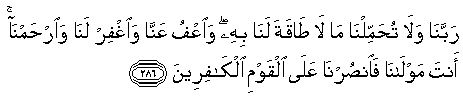
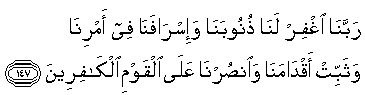
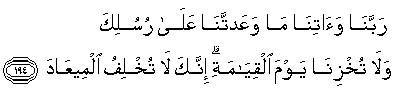
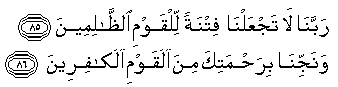
It is advisable to lengthen the Qunut, There are many supplications which can be recited. Qunoot dt Page
25 Quranic Qunoot
Qunoot 1
Qunoot 2
Qunoot 3
25 Qunoot from Quran Pdf












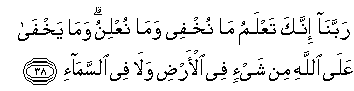


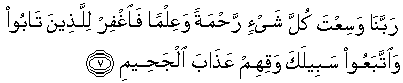





Questions on Qunoot