Duas.org recommends
downloading and Installing these fonts to view the
content on this page: NAJAF | VERDANA TRANSLITERATION
Duas.org recommends
downloading and Installing these fonts to view the
content on this page: NAJAF | VERDANA TRANSLITERATION
The Holy Prophet(pbuh) held out the hand of Ali(as) and said: " For whoever I am his Leader (mawla), 'Ali is his Leader (mawla)."
Click here for Complete Ghadir Sermon(Khutba) | Other Ghadir page | PDF this pg | All Aamaal PDF | Mobile page Extracts from Iqbal Aamaal book
The `«d al-Ghad¢r is the greatest feast day of Almighty Allah. It is also the feast of the Holy Prophet’s Household. It is in fact the most celebrated feast day. All the Prophets that Almighty Allah appointed used to celebrate this day and maintain its sanctity. In the heavens, this day is called “the Day of the Promised Covenant” and in the earth “the Day of the Exacted Covenant and the Witnessed Crowd.”
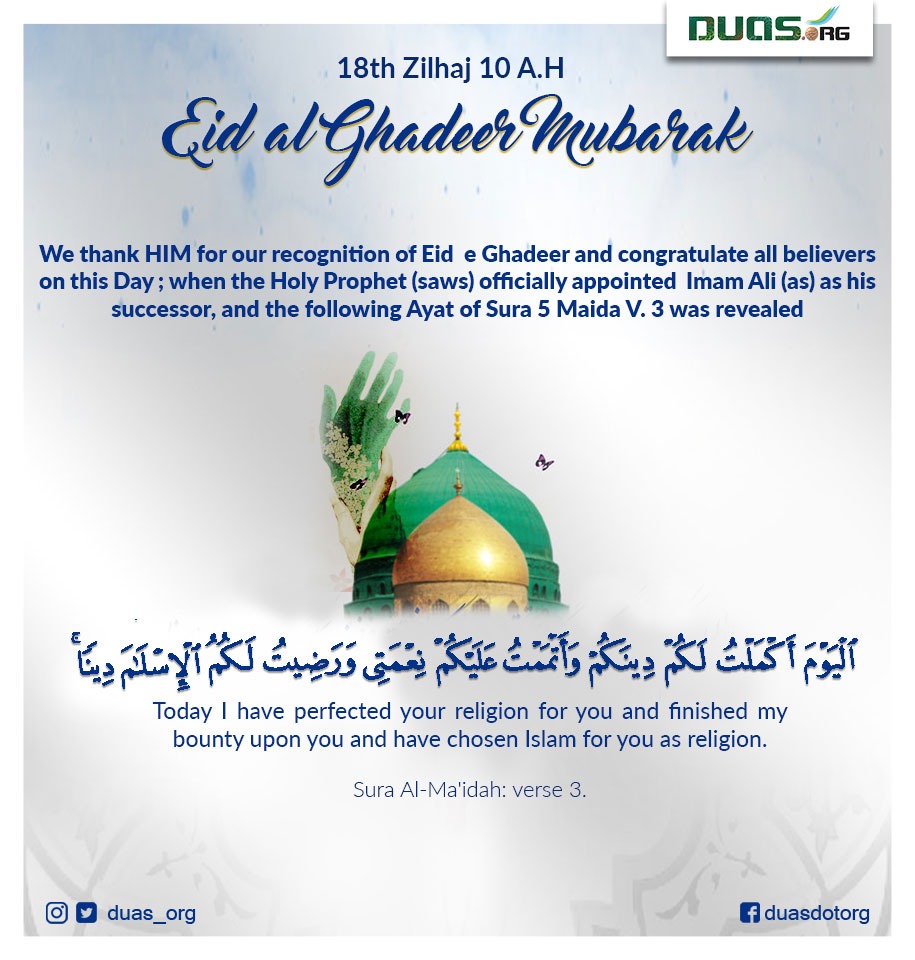
It has been narrated that when Imam al-¯¡diq (`a) was asked whether Muslims have a feast day other than `«d al-Fi§r, `«d al-A¤h¡, and Fridays, he answered, “Yes, they have. There is still the holiest feast day, which falls on the day when the Messenger of Allah (`a) appointed Am¢r al-Mu'min¢n -Imam `Al¢- (`a) (as his successor and the coming leader of the Muslim community). On that day, the Holy Prophet (¥) declared, ‘Whoever has regarded me as his master must now regard `Al¢ as his master.’ It falls on the eighteenth of Dhu’l-°ijjah.”
When he was asked about the deeds that should be done on that day, Imam al-¯¡diq (`a) instructed, “(The best acts on this day are) observance of fasting, acts of worship, mention of the Household of the Holy Prophet, and invocation of blessings upon them. The Holy Messenger of Allah (`a) instructed Imam `Al¢ Am¢r al-Mu'min¢n (`a) to betake that day as feast. Similarly, the Prophets (`a) used to instruct their successors to betake the eighteenth of Dhu’l-°ijjah as feast day.”
Ab£-Na¥r al-Bizan§¢ has narrated that Imam al-Ri¤¡ (`a) said to him, “Wherever you are, try to be present on the Ghad¢r Day at the tomb of Imam `Al¢ Am¢r al-Mu'min¢n (`a). Verily, Almighty Allah will forgive the sins of sixty years for any believer and Muslim—male and female—on that day and will release from Hellfire twice as many as the number of those whom He releases from Hellfire in the month of Rama¤¡n, at the Qadr Night and at the `«d al-Fi§r Night. A single dirham (a currency) that is given as alms on this day to the believing brethren is equal to one thousand dirhams (that are given as alms on other occasions). Try to do favors to your brethren on this day and try to please each believing man and woman. By Allah I swear, if people recognized the reality of this day, the angels should shake hands with them ten times a day.”
On the night of Ghadeer ,it is recommended to recite 12 rakat salat & then this dua pdf
The devotional acts on the `«d al-Ghad¢r Day are as follows:
First: It is recommended to observe fasting on this day, for it erases the sins of sixty years. Furthermore, it has been narrated that to observe fasting on this day is equal to the observance of fasting of one’s whole lifetime and its reward is equal to the rewards of one hundred times of °ajj and `Umrah.
Second: It is recommended to do ghusl/bathe oneself on this day.
Third: It is recommended to visit the holy tomb of Imam `Al¢ Am¢r al-Mu'min¢n (`a). It is necessary to do one’s best to attend at the holy tomb of Imam `Al¢ (`a) on this day even if such a journey be difficult. Three forms of Ziy¡r¡t have been decided for this day. The first is the familiar Ziy¡rat Am¢null¡h, which can be recited whether one is present at the holy tomb or is far away from it. also ii Special Ghadir Ziarat and & short ziarat (iii) Ziarat Mut'laqah
Fourth: It is recommended to say the supplication of seeking Almighty Allah’s protection against Satan (i.e. Isti`¡dhah), which is mentioned by Sayyid Ibn ±¡w£s, in his book of Iqb¡l al-A`m¡l, who has reported it from the Holy Prophet (¥).Prophets dua pdf
Fifth: It is recommended to offer a two unit prayer. In the first Rakat recite Sura Qadr after Sura Fatihah & in the second Rakat recite Sura Ikhlass after Sura Fatiha. After that one should prostrate oneself and thank Almighty Allah"Shukran lillah " one hundred times. Then, one should raise the head from the prostration and say the following: Ppt | Pdf | Pdf 3 col |Mp3 sedghi | Mp3
|
اَللَّهُمَّ إِنِّي سْلُكَ بِنَّ لَكَ ٱلْحَمْدَ |
all¡humma inn¢ as'aluka bi'anna laka alhamda |
O Allah, I beseech You in the name of that all praise be to You, |
|
وَحْدَكَ لاَ شَرِيكَ لَكَ |
wahdaka l¡ shar¢ka laka |
alone, without having any partner, |
|
وَنَّكَ وَاحِدٌ حَدٌ صَمَدٌ |
wa annaka w¡hidun ahadun ¥amadun |
and that You are One, One and Only, and eternally Besought of all; |
|
لَمْ تَلِدْ وَلَمْ تُولَدْ |
lam talid wa lam t£lad |
You beget not nor are You begotten, |
|
وَلَمْ يَكُنْ لَكَ كُفُواً حَدٌ |
wa lam yakun laka kufwan ahadun |
and there is none like You; |
|
وَنَّ مُحَمَّداً عَبْدُكَ وَرَسُولُكَ |
wa anna muhammadan `abduka wa ras£luka |
and that Muhammad is Your servant and Messenger, |
|
صَلَوَاتُكَ عَلَيْهِ وَآلِهِ |
¥alaw¡tuka `alayhi wa ¡lih¢ |
Your blessings be upon him and his Household. |
|
يَا مَنْ هُوَ كُلَّ يَوْمٍ فِي شَانٍ |
y¡ man huwa kulla yawmin f¢ sha'nin |
O He Who is in a state every day! |
|
كَمَا كَانَ مِنْ شَانِكَ نْ تَفَضَّلْتَ عَلَيَّ |
kam¡ k¡na min sha'nika an tafa¤¤alta `alayya |
Just as You decided to confer upon me with Your favor |
|
بِنْ جَعَلْتَنِي مِنْ هْلِ إِجَابَتِكَ |
bi'an ja`altan¢ min ahli ij¡batika |
when You included me with those to whom You responded, |
|
وَهْلِ دِينِكَ |
wa ahli d¢nika |
the company of Your religion, |
|
وَهْلِ دَعْوَتِكَ |
wa ahli da`watika |
and the company of those who pray You, |
|
وَوَفَّقْتَنِي لِذٰلِكَ فِي مُبْتَدَءِ خَلْقِي |
wa waffaqtan¢ lidh¡lika f¢ mubtada'i khalq¢ |
You had led me to this in the beginning of Your creation of me |
|
تَفَضُّلاً مِنْكَ وَكَرَماً وَجُوداً |
tafa¤¤ulan minka wa karaman wa j£dan |
as a sign of Your favoring, generosity, and magnanimity. |
|
ثُمَّ رْدَفْتَ ٱلْفَضْلَ فَضْلاًَ |
thumma ardafta alfa¤la fa¤lan |
Then, You followed the favor with another favor, |
|
وَٱلْجُودَ جُوداً |
walj£da j£dan |
the magnanimity with another magnanimity, |
|
وَٱلْكَرَمَ كَرَماً |
walkarama karaman |
and the generosity with another generosity, |
|
رَافَةً مِنْكَ وَرَحْمَةً |
ra'fatan minka wa rahmatan |
on account of Your kindness and mercy, |
|
إِلَىٰ نْ جَدَّدْتَ ذٰلِكَ ٱلْعَهْدَ لِي تَجْدِيداً |
il¡ an jaddadta dh¡lika al`ahda l¢ tajd¢dan |
so You renewed all that for me over again |
|
بَعْدَ تَجدِيدِكَ خَلْقِي |
ba`da tajd¢dika khalq¢ |
after You renewed my creation |
|
وَكُنْتُ نَسْياً مَنْسِيّاً |
wa kuntu nasyan mansiyyan |
while I was a thing quite forgotten, |
|
نَاسِياً سَاهِياً غَافِلاًَ |
n¡siyan s¡hiyan gh¡filan |
oblivious, unmindful, and heedless. |
|
فَتْمَمْتَ نِعْمَتَكَ |
fa'atmamta ni`mataka |
So, You completed Your grace |
|
بِنْ ذَكَّرْتَنِي ذٰلِكَ |
bi'an dhakkartan¢ dh¡lika |
when You made me remember that, |
|
وَمَنَنْتَ بِهِ عَلَيَّ |
wa mananta bih¢ `alayya |
bestowed this favor upon me, |
|
وَهَدَيْتَنِي لَهُ |
wa hadaytan¢ lah£ |
and guided me to it. |
|
فَليَكُنْ مِنْ شَانِكَ |
falyakun min sha'nika |
So, (please) may one of Your decisions, |
|
يَا إِلٰهِي وَسَيِّدِي وَمَولاَيَ |
y¡ il¡h¢ wa sayyid¢ wa mawl¡ya |
O my God, Master, and Sustainer, |
|
نْ تُتِمَّ لِي ذٰلِكَ وَلاَ تَسْلُبْنيهِ |
an tutimma l¢ dh¡lika wa l¡ taslubn¢hi |
be that You perfect this for me and never deprive me of it |
|
حَتَّىٰ تَتَوَفَّانِي عَلَىٰ ذٰلِكَ |
hatt¡ tatawaff¡n¢ `al¡ dh¡lika |
until You cause me to die on this faith |
|
وَنْتَ عَنِّي رَاضٍ |
wa anta `ann¢ r¡¤in |
and You are pleased with me. |
|
فَإِنَّكَ حَقُّ ٱلْمُنعِمِينَ |
fa'innaka ahaqqu almun`im¢na |
For, verily, You are the worthiest Benefactor |
|
نْ تُتِمَّ نِعْمَتَكَ عَلَيَّ |
an tutimma ni`mataka `alayya |
of perfecting Your grace for me. |
|
اَللَّهُمَّ سَمِعْنَا وَطَعْنَا |
all¡humma sami`n¡ wa a§a`n¡ |
O Allah, we have listened, obeyed, |
|
وَجَبْنَا دَاعِيَكَ بِمَنِّكَ |
wa ajabn¡ d¡`iyaka bimannika |
and answered Your call on account of Your favor to us. |
|
فَلَكَ ٱلْحَمْدُ |
falaka alhamdu |
So, all praise be to You. |
|
غُفْرَانَكَ رَبَّنَا |
ghufr¡naka rabban¡ |
Your forgiveness, O our Lord, we seek |
|
وَإِلَيْكَ ٱلْمَصِيرُ |
wa ilayka alma¥¢ru |
and to You is the return. |
|
آمَنَّا بِٱللَّهِ وَحْدَهُ |
¡mann¡ bill¡hi wahdah£ |
We believe in Allah, alone; |
|
لاَ شَرِيكَ لَهُ |
l¡ shar¢ka lah£ |
there is no partner with Him, |
|
وَبِرَسُولِهِ مُحَمَّدٍ |
wa biras£lih¢ muhammadin |
and (we believe) in His Messenger, Muhammad, |
|
صَلَّىٰ ٱللَّهُ عَلَيْهِ وَآلِهِ |
¥all¡ all¡hu `alayhi wa ¡lih¢ |
may Allah’s blessings be upon him and his Household, |
|
وَصَدَّقْنَا وَجَبْنَا دَاعِيَ ٱللَّهِ |
wa ¥addaqn¡ wa ajabn¡ d¡`iya all¡hi |
we trust and respond to the caller of Allah, |
|
وَٱتَّبَعْنَا الرَّسُولَ فِي مُوَالاَةِ مَوْلاَنَا |
wattaba`n¡ alrras£la f¢ muw¡l¡ti mawl¡n¡ |
we followed the Messenger as regards the loyalty to our master, |
|
وَمَوْلَىٰ ٱلْمُؤْمِنِينَ |
wa mawl¡ almu'min¢na |
and the master of the believers, |
|
مِيرِ ٱلْمُؤْمِنِينَ |
am¢ri almu'min¢na |
the commander of the believers, |
|
عَلِيِّ بْنِ بِي طَالِبٍ |
`aliyyi bni ab¢ §¡libin |
`Al¢, the son of Ab£-±¡lib, |
|
عَبْدِ ٱللَّهِ وَخِي رَسُولِهِ |
`abdi all¡hi wa akh¢ ras£lih¢ |
Allah’s servant and His Messenger’s brother, |
|
وَٱلصِّدِّيقِ ٱلكْبَرِ |
wal¥¥idd¢qi al'akbari |
the grandest veracious, |
|
وَٱلْحُجَّةِ عَلَىٰ بَرِيَّتِهِ |
walhujjati `al¡ bariyyatih¢ |
the claim on His creation, |
|
ٱلْمُؤَيِّدِ بِهِ نَبِيَّهُ |
almu'ayyidi bih¢ nabiyyah£ |
by him, He supported His Prophet |
|
وَدِينَهُ ٱلْحَقَّ ٱلْمُبِينَ |
wa d¢nah£ alhaqqa almub¢na |
and His religion, the manifest true. |
|
عَلَماً لِدِينِ ٱللَّهِ |
`alaman lid¢ni all¡hi |
(We believe in him as) the sign of Allah’s religion, |
|
وَخَازِناً لِعِلْمِهِ |
wa kh¡zinan li`ilmih¢ |
the keeper of His knowledge, |
|
وَعَيْبَةَ غَيْبِ ٱللَّهِ |
wa `aybata ghaybi all¡hi |
the container of Allah’s unseen affairs, |
|
وَمَوْضِعَ سِرِّ ٱللَّهِ |
wa maw¤i`a sirri all¡hi |
the carrier of Allah’s secrets, |
|
وَمِينَ ٱللَّهِ عَلَىٰ خَلْقِهِ |
wa am¢na all¡hi `al¡ khalqih¢ |
the trustee of Allah on His creatures, |
|
وَشَاهِدَهُ فِي بَرِيَّتِهِ |
wa sh¡hidah£ f¢ bariyyatih¢ |
and His witness on His created beings. |
|
اَللَّهُمَّ رَبَّنَا إِنَّنَا سَمِعْنَا مُنَادِياً |
all¡humma rabban¡ innan¡ sami`n¡ mun¡diyan |
O Allah, O our Lord, surely, we have heard a preacher |
|
يُنَادِي لِلإِيـمَانِ نْ آمِنُوٱ بِرَبِّكُمْ فَآمَنَّا |
yun¡d¢ lil'¢m¡ni an ¡min£ birabbikum fa'¡mann¡ |
calling to the faith, saying, “Believe in your Lord.” So, we did believe. |
|
رَبَّنَا فَٱغْفِرْ لَنَا ذُنُوبَنَا |
rabban¡ faghfir lan¡ dhun£ban¡ |
Our Lord! Forgive us therefore our faults, |
|
وَكَفِّرْ عَنَّا سَيِّئَاتِنَا |
wa kaffir `ann¡ sayyi'¡tin¡ |
cover our evil deeds, |
|
وَتَوَفَّنَا مَعَ ٱلبْرَارِ |
wa tawaffan¡ ma`a al'abr¡ri |
and make us die with the righteous ones. |
|
رَبَّنَا وَآتِنَا مَا وَعَدْتَنَا عَلَىٰ رُسُلِكَ |
rabban¡ wa ¡tin¡ m¡ wa`adtan¡ `al¡ rusulika |
Our Lord! And grant us what You have promised us by Your messengers; |
|
وَلاَ تُخْزِنَا يَوْمَ ٱلْقِيَامَةِ |
wa l¡ tukhzin¡ yawma alqiy¡mati |
and disgrace us not on the Day of Resurrection. |
|
إِنَّكَ لاَ تُخْلِفُ ٱلْمِيعَادَ |
innaka l¡ tukhlifu alm¢`¡da |
Surely, You do not fail to perform the promise. |
|
فَإِنَّا يَا رَبَّنَا بِمَنِّكَ وَلُطْفِكَ |
fa'inn¡ y¡ rabban¡ bimannika wa lu§fika |
Because we, O our Lord, on account of Your grace and kindness, |
|
جَبْنَا دَاعِيَكَ |
ajabn¡ d¡`iyaka |
responded to Your caller |
|
وَٱتَّبَعْنَا ٱلرَّسُولَ وَصَدَّقْنَاهُ |
wattaba`n¡ alrras£la wa ¥addaqn¡hu |
followed the Messenger, believed him, |
|
وَصَدَّقْنَا مَوْلَىٰ ٱلْمُؤْمِنِينَ |
wa ¥addqn¡ mawl¡ almu'min¢na |
trusted the Master of the Believers, |
|
وَكَفَرْنَا بِٱلْجِبْتِ وَٱلطَّاغُوتِ |
wa kafarn¡ biljibti wal§§¡gh£ti |
and denied the idols (Jibt) and false deities (Taghut). |
|
فَوَلِّنَا مَا تَوَلَّيْنَا |
fawallin¡ m¡ tawallayn¡ |
So, (please) join us with those whom we chose to join |
|
وَٱحْشُرْنَا مَعَ ئِمَّتِنَا |
wahshurn¡ ma`a a'immatin¡ |
and put us in the group of our Imams, |
|
فَإِنَّا بِهِمْ مُؤْمِنُونَ مُوقِنُونَ |
fa'inn¡ bihim mu'min£na m£qin£na |
for we do believe in them with absolute belief, |
|
وَلَهُمْ مُسَلِّمُونَ |
wa lahum musallim£na |
and to them we do submit. |
|
آمَنَّا بِسِرِّهِمْ وَعَلاَنِيَتِهِمْ |
¡mann¡ bisirrihim wa `al¡niyatihim |
We believe in their secret and open affairs, |
|
وَشَاهِدِهِمْ وَغَائِبِهِمْ |
wa sh¡hidihim wa gh¡'ibihim |
their present and their absent ones, |
|
وَحَيِّهِمْ وَمَيِّتِهِمْ |
wa hayyihim wa mayyitihim |
and their living and their dead ones. |
|
وَرَضِينَا بِهِمْ ئِمَّةً |
wa ra¤¢n¡ bihim a'immatan |
We consent to them as our imams, |
|
وَقَادَةً وَسَادَةً |
wa q¡datan wa s¡datan |
leaders, and chiefs. |
|
وَحَسْبُنَا بِهِمْ |
wa hasbun¡ bihim |
And we stop at them |
|
بَيْنَنَا وَبَيْنَ ٱللَّهِ دُونَ خَلْقِهِ |
baynan¡ wa bayna all¡hi d£na khalqih¢ |
in all of our affairs with Allah, excluding all other creatures of Him. |
|
لاَ نَبْتَغِي بِهِمْ بَدَلاًَ |
l¡ nabtagh¢ bihim badalan |
We do not seek any substitutes of them, |
|
وَلاَ نَتَّخِذُ مِنْ دُونِهِمْ وَلِيجَةً |
wa l¡ nattakhidhu min d£nihim wal¢jatan |
and we do not betake ourselves any friends other than them. |
|
وَبَرِئْنَا إِلَىٰ ٱللَّهِ |
wa bari'n¡ il¡ all¡hi |
We, before Allah, disapprove |
|
مِنْ كُلِّ مَنْ نَصَبَ لَهُمْ حَرْباً |
min kulli man na¥aba lahum harban |
all those who made war with them, |
|
مِنَ ٱلْجِنِّ وَٱلإِنْسِ |
min aljinn wal'insi |
from jinn and men, |
|
مِنَ ٱلوَّلِينَ وَٱلآخِرِينَ |
min al'awwal¢na wal'¡khir¢na |
from the past and the coming generations. |
|
وَكَفَرْنَا بِٱلْجِبْتِ وَٱلطَّاغُوتِ |
wa kafarn¡ biljibti wal§§¡gh£ti |
We deny the idols, the false deities, |
|
وَٱلوْثَانِ ٱلرْبَعَةِ |
wal-awth¡ni al'arba`ati |
the four pagans, |
|
وَشْيَاعِهِمْ وَتْبَاعِهِمْ |
wa ashy¡`ihim wa atb¡`ihim |
their partisans, their followers, |
|
وَكُلِّ مَنْ وَالاَهُمْ |
wa kulli man w¡l¡hum |
and all those who support them |
|
مِنَ ٱلْجِنِّ وَٱلإِنْسِ |
min aljinni wal'insi |
from jinn and human beings |
|
مِنْ وَّلِ ٱلدَّهْرِ إِلَىٰ آخِرِهِ |
min awwali alddahri il¡ ¡khirih¢ |
from the first of time to the last of it. |
|
اَللَّهُمَّ إِنَّا نُشْهِدُكَ |
all¡humma inn¡ nushhiduka |
O Allah, we call You to witness |
|
نَّا نَدِينُ بِمَا دَانَ بِهِ مُحَمَّدٌ وَآلُ مُحَمَّدٍ |
anna¡ nad¢nu bim¡ d¡na bih¢ muhammadun wa ¡lu muhammadin |
that we profess all that professed by Muhammad and the Household of Muhammad, |
|
صَلَّىٰ ٱللَّهُ عَلَيْهِ وَعَلَيْهِمْ |
¥all¡ all¡hu `alayhi wa `alayhim |
Allah’s blessings be upon him and them. |
|
وَقَوْلُنَا مَا قَالُوٱ |
wa qawlun¡ m¡ q¡lw¡ |
We say only that which they say |
|
وَدِينُنَا مَا دَانُوٱ بِهِ |
wa d¢nun¡ m¡ d¡n£ bih¢ |
and we believe in only that in which they believe. |
|
مَا قَالُوٱ بِهِ قُلْنَا |
m¡ q¡l£ bih¢ quln¡ |
What they say is our saying, |
|
وَمَا دَانُوٱ بِهِ دِنَّا |
wa m¡ d¡n£ bih¢ dinn¡ |
what they profess is what we profess, |
|
وَمَا نْكَرُوٱ نْكَرْنَا |
wa m¡ ankar£ ankarn¡ |
what they reject is what we reject, |
|
وَمَنْ وَالَوْٱ وَالَيْنَا |
wa man w¡law w¡layn¡ |
those to whom they adhere are they to whom we adhere, |
|
وَمَنْ عَادَوْٱ عَادَيْنَا |
wa man `¡daw `¡dayn¡ |
those whom they oppose are they whom we oppose, |
|
وَمَنْ لَعَنُوٱ لَعَنَّا |
wa man la`an£ la`ann¡ |
those whom they curse are they whom we curse, |
|
وَمَنْ تَبَرَّؤُٱ مِنهُ تَبَرَّانَا مِنْهُ |
wa man tabarra'£ minhu tabarra'n¡ minhu |
those whom they condemn are they whom we condemn, |
|
وَمَنْ تَرَحَّمُوٱ عَلَيْهِ تَرَحَّمْنَا عَلَيْهِ |
wa man tarahham£ `alayhi tarahhamn¡ `alayhi |
and those to whom they pray for mercy are they to whom we pray for mercy. |
|
آمَنَّا وَسَلَّمْنَا |
¡mann¡ wa sallamn¡ |
We believe in, submit to, |
|
وَرَضِينَا وَٱتَّبَعْنَا مَوَالِيَنَا |
wa ra¤¢n¡ wattaba`n¡ maw¡liyan¡ |
accept, and follow our masters, |
|
صَلَوَاتُ ٱللَّهِ عَلَيْهِمْ |
¥alaw¡tu all¡hi `alayhim |
Allah’s blessings be upon them. |
|
اَللَّهُمَّ فَتِمِّمْ لَنَا ذٰلِكَ وَلاَ تَسْلُبْنَاهُ |
all¡humma fatammim lan¡ dh¡lika wa l¡ taslubn¡hu |
O Allah, so, perfect this for us and do not deprive us of it. |
|
وَٱجْعَلْهُ مُسْتَقِرّاً ثَابِتاً عِنْدَنَا |
waj`alhu mustaqirran th¡bitan `indan¡ |
Make it well-established and fixed with us |
|
وَلاَ تَجْعَلْهُ مُسْتَعَاراً |
wa l¡ taj`alhu musta`¡ran |
and do not make it temporal (belief). |
|
وَحْيِنَا مَا حْيَيْتَنَا عَلَيْهِ |
wa ahyin¡ m¡ ahyaytan¡ `alayhi |
Make us live on it (no matter how long You will make us to live) |
|
وَمِتْنَا إِذَا مَتَّنَا عَلَيْهِ |
wa amitn¡ idh¡ amattan¡ `alayhi |
and cause us to die on it (when You decide to terminate our lives). |
|
آلُ مُحَمَّدٍ ئِمَّتُنَا |
¡lu muhammadin a'immatun¡ |
Muhammad’s Household are our Imams; |
|
فَبِهِمْ نَاتَمُّ |
fabihim na'tammu |
so, we follow them |
|
وَإِيَّاهُمْ نُوَالِي |
wa iyy¡hum nuw¡l¢ |
and act loyally to them. |
|
وَعَدُوَّهُمْ عَدُوَّ ٱللَّهِ نُعَادِي |
wa `aduwwahum `aduwwa all¡hi nu`¡d¢ |
We oppose their enemy, the enemy of Allah; |
|
فَٱجْعَلْنَا مَعَهُمْ فِي ٱلدُّنْيَا وَٱلآخِرَةِ |
faj`aln¡ ma`ahum f¢ aldduny¡ wal'¡khirati |
so, (please) include us with them in this world and the Hereafter, |
|
وَمِنَ ٱلْمُقَرَّبِينَ |
wa min almuqarrab¢na |
and make us of those drawn near (to You), |
|
فَإِنَّا بِذٰلِكَ رَاضُونَ |
fa'inn¡ bidh¡lika r¡¤£na |
for we are satisfied with that. |
|
يَا رْحَمَ ٱلرَّاحِمينَ |
y¡ arhama alrr¡him¢na |
O most Merciful of all those who show mercy! |
One may then prostrate oneself again and repeat each of the following doxological prayers one hundred times:
|
All praise be to Allah. |
alhamdu lill¡hi |
اَلْحَمْدُ لِلَّهِ |
|
Thanks be to Allah. |
shukran lill¡hi |
شُكْراً لِلَّهِ |
According to a narration, to practice this act brings about the same reward of one who was present at that day and swore allegiance to the Holy Prophet (¥) as regards the divinely commissioned leadership (wil¡yah) of Imam `Al¢ (`a). Besides, it is preferable to offer this prayer at midday, which is the very time when the Holy Prophet (¥) declared the successorship and leadership of Imam `Al¢ (`a) at Ghad¢r Khumm. It is also preferable to recite S£rah al-Qadr at the first unit of the prayer and S£rah al-Tawh¢d at the second (of course, after S£rah al-F¡tihah).
Sixth: It is recommended to bathe oneself and offer a two unit prayer half an hour before midday. At each unit, one should recite Sura al-F¡tihah once, S£rah al-Tawh¢d ten times, ªyah al-Kurs¢ ten times, and S£rah al-Qadr ten times. The reward of practicing this act is equal, in the sight of Almighty Allah, to the rewards of one hundred thousand times of °ajj and one hundred thousand times of `Umrah. Almighty Allah will also grant all the worldly and religious needs of the performer with easiness and good health.
Note Sayyid Ibn ±¡w£s, in Iqb¡l al-A`m¡l, referring to this prayer, has preceded S£rah al-Qadr to ªyah al-Kurs¢. Also, `All¡mah al-Majlis¢, in Z¡d al-Ma`¡d, mentioned that S£rah al-Qadr should be preceded to ªyah al-Kurs¢.
After the salat recite this Dua " Pdf
|
O Our Lord, we have heard a caller… |
rabban¡ innan¡ sami`n¡ mun¡diyan... |
رَبَّنَا إِنَّنَا سَمِعْنَا مُنَادِياً… |
Seventh: It is recommended to say Du`¡' al-Nudbah,
Eighth: It is recommended to say the following prayer, which is reported by Sayyid Ibn ±¡w£s from Shaykh al-Muf¢d:
pdf-arabic only Pdf Mp3 farhamand Mp3
|
اَللَّهُمَّ إِنِّي سْلُكَ بِحَقِّ مُحَمَّدٍ نَبِيِّكَ |
all¡humma inn¢ as'aluka bihaqqi muhammadin nabiyyika |
O Allah, I beseech You in the name of Muhammad, Your Prophet, |
|
وَعَلِيٍّ وَلِيِّكَ |
wa `aliyyin waliyyika |
in the name of `Ali, Your Representative (wali), |
|
وَٱلشَّانِ وَٱلْقَدْرِ ٱلَّذِي خَصَصَتْهُمَا بِه دُونَ خَلقِكَ |
walshsha'ni walqadri alladh¢ kha¥a¥tahum¡ bih¢ d£na khalqika |
and in the name of the stature and standing that You have given exclusively to them rather than Your other creatures, |
|
نْ تُصَلِّيَ عَلَىٰ مُحَمَّدٍ وَعَلِيٍّ |
an tu¥alliya `al¡ muhammadin wa `aliyyin |
to send blessings to Muhammad and `Ali |
|
وَنْ تَبْدَ بِهِمَا فِي كُلِّ خَيْرٍ عَاجِلٍ |
wa an tabda'a bihim¡ f¢ kulli khayrin `¡jilin |
and begin with both of them in any immediate item of goodness. |
|
اَللَّهُمَّ صَلِّ عَلَىٰ مُحَمَّدٍ وَآلِ مُحَمَّدٍ |
all¡humma ¥alli `al¡ muhammadin wa ¡li muhammadin |
O Allah, (please do) send blessings to Muhammad and the Household of Muhammad; |
|
ٱلئِمَّةِ ٱلْقَادَةِ |
al'a'immati alq¡dati |
the Imams, the leaders, |
|
وَٱلدُّعَاةِ ٱلسَّادَةِ |
walddu`ati alss¡dati |
the promulgators (to You), the masters, |
|
وَٱلنُّجُومِ ٱلزَّاهِرَةِ |
walnnuj£mi alzz¡hirati |
the shining stars, |
|
وَٱلعْلاَمِ ٱلْبَاهِرَةِ |
wal'a`l¡mi alb¡hirati |
the splendid signs, |
|
وَسَاسَةِ ٱلْعِبَادِ |
wa s¡sati al`ib¡di |
the governors of the servants (of You), |
|
وَرْكَانِ ٱلْبِلاَدِ |
wa ark¡ni albil¡di |
the pillars of the countries, |
|
وَٱلنَّاقَةِ ٱلْمُرْسَلَةِ |
walnn¡qati almursalati |
the (like of the) she-camel that was sent by You, |
|
وَٱلسَّفِينَةِ ٱلنَّاجيَةِ |
walssaf¢nati alnn¡jiyati |
and the ark that saves (from sinking in straying off from the right path) |
|
ٱلْجَارِيَةِ فِي ٱلْلُّجَجِ ٱلْغَامِرَةِ |
alj¡riyati f¢ allujaji algh¡mirati |
and runs peacefully in the depths of oceans. |
|
اَللَّهُمَّ صَلِّ عَلَىٰ مُحَمَّدٍ وَآلِ مُحَمَّدٍ |
all¡humma ¥alli `al¡ muhammadin wa ¡li muhammadin |
O Allah, (please do) send blessings to Muhammad and the Household of Muhammad; |
|
خُزَّانِ عِلْمِكَ |
khuzz¡ni `ilmika |
the keepers of Your knowledge, |
|
وَرْكَانِ تَوْحِيدِكَ |
wa ark¡ni tawh¢dika |
the pillars of the professing of Your Oneness, |
|
وَدَعَائِمِ دِينِكَ |
wa da`¡'imi d¢nika |
the supports of Your religion, |
|
وَمَعَادِنِ كَرَامَتِكَ |
wa ma`¡dini kar¡matika |
the cores of Your honoring, |
|
وَصِفْوَتِكَ مِنْ بَرِيَّتِكَ |
wa ¥afwatika min bariyyatika |
the choicest among Your creatures, |
|
وَخِيَرَتِكَ مِنْ خَلْقِكَ |
wa khiyaratika min khalqika |
the best of Your beings, |
|
التْقِيَاءِ ٱلنْقِيَاءِ |
al'atqiy¡'i al'anqiy¡'i |
the pious, the pure, |
|
ٱلنُّجَبَاءِ ٱلبْرَارِ |
alnnujab¡'i al'abr¡ri |
the outstanding, the virtuous, |
|
وَٱلْبَابِ ٱلْمُبْتَلَىٰ بِهِ ٱلنَّاسُ |
walb¡bi almubtal¡ bih¢ alnn¡su |
and the door that is decided as trial for people— |
|
مَنْ تَاهُ نَجَىٰ |
man at¡hu naj¡ |
he who comes through it shall be saved |
|
وَمَنْ بَاهُ هَوَىٰ |
wa man ab¡hu haw¡ |
but he who rejects it shall fail indeed. |
|
اَللَّهُمَّ صَلِّ عَلَىٰ مُحَمَّدٍ وَآلِ مُحَمَّدٍ |
all¡humma ¥alli `al¡ muhammadin wa ¡li muhammadin |
O Allah, (please do) send blessings to Muhammad and the Household of Muhammad; |
|
هْلِ ٱلذِّكْرِ ٱلَّذِينَ مَرْتَ بِمَسْلَتِهِمْ |
ahli aldhdhikri alladh¢na amarta bimas'alatihim |
the People of the Reminder whom You have ordered us to ask (when we do not know), |
|
وَذَوِي ٱلْقُرْبَىٰ ٱلَّذينَ مَرْتَ بِمَوَدَّتِهِمْ |
wa dhaw¢ alqurb¡ alladh¢na amarta bimawaddatihim |
the near relatives (of the Holy Prophet) whom You have ordered us to love, |
|
وَفَرَضْتَ حَقَّهُمْ |
wa fara¤ta haqqahum |
whose rights You have made incumbent (upon us), |
|
وَجَعَلْتَ ٱلْجَنَّةَ مَعَادَ مَنِ ٱقْتَصَّ آثَارَهُمْ |
wa ja`alta aljannata ma`¡da man iqta¥¥a ¡th¡rahum |
and whom You have decided Paradise as the reward of whoever follows their patterns. |
|
اَللَّهُمَّ صَلِّ عَلَىٰ مُحَمَّدٍ وَآلِ مُحَمَّدٍ |
all¡humma ¥alli `al¡ muhammadin wa ¡li muhammadin |
O Allah, (please do) send blessings to Muhammad and the Household of Muhammad |
|
كَمَا مَرُوٱ بِطَاعَتِكَ |
kam¡ amar£ bi§¡`atika |
as they instructed (us) to obey You, |
|
وَنَهَوْٱ عَنْ مَعْصِيَتِكَ |
wa nahaw `an ma`¥iyatika |
warned (us) against disobeying You, |
|
وَدَلُّوٱ عِبَادَكَ عَلَىٰ وَحْدَانِيَّتِكَ |
wa dall£ `ib¡daka `al¡ wahd¡niyyatika |
and led Your servants to Your Oneness. |
|
اَللَّهُمَّ إِنِّي سْلُكَ بِحَقِّ مُحَمَّدٍ |
all¡humma inn¢ as'aluka bihaqqi muhammadin |
O Allah, I beseech You in the name of Muhammad; |
|
نَبِيِّكَ وَنَجِيبِكَ |
nabiyyika wa naj¢bika |
Your Prophet, Your superior servant, |
|
وَصَفْوَتِكَ وَمِينِكَ |
wa ¥afwatika wa am¢nika |
Your choice, Your trusted one, |
|
وَرَسُولِكَ إِلَىٰ خَلْقِكَ |
wa ras£lika il¡ khalqika |
Your messenger to Your creatures; |
|
وَبِحَقِّ مِيرِ ٱلْمُؤْمِنِينَ |
wa bihaqqi am¢ri almu'min¢na |
and (I beseech You) in the name of the Commander of the Believers (Am¢r al-Mu'min¢n), |
|
وَيَعْسُوبِ ٱلدِّينِ |
wa ya`s£bi aldd¢ni |
the chief of the religion, |
|
وَقَائِدِ ٱلْغُرِّ ٱلْمُحَجَّلِينَ |
wa q¡'idi alghurri almuhajjal¢na |
the leader of the white-faced and marked on the foreheads, |
|
ٱلْوَصِيِّ ٱلْوَفِيِّ |
alwa¥iyyi alwafiyyi |
the faithful, the loyal, |
|
وَٱلصِّدِّيقِ ٱلكْبَرِ |
wal¥¥idd¢qi al'akbari |
the greatest veracious, |
|
وَٱلْفَارُوقِ بَيْنَ ٱلْحَقِّ وَٱلْبَاطِلِ |
walf¡r£qi bayna alhaqqi walb¡§ili |
the distinguisher between the right and the wrong, |
|
وَٱلشَّاهِدِ لَكَ |
walshsh¡hidi laka |
the witness for You, |
|
وَٱلدَّالِّ عَلَيْكَ |
waldd¡lli `alayka |
the guide to You, |
|
وَٱلصَّادِعِ بِمْرِكَ |
wal¥¥¡di`i bi'amrika |
the expounder of what You have commanded, |
|
وَٱلْمُجَاهِدِ فِي سَبِيلِكَ |
walmuj¡hidi f¢ sab¢lika |
the striver in Your way, |
|
لَمْ تَاخُذْهُ فِيكَ لَوْمَةُ لاَئِمٍ |
lam ta'khudhhu f¢ka lawmatu l¡'imin |
and who never listened to any word of blame for Your sake; |
|
نْ تُصَلِّيَ عَلَىٰ مُحَمَّدٍ وَآلِ مُحَمَّدٍ |
an tu¥alliya `al¡ muhammadin wa ¡li muhammadin |
(I beseech You) to send blessings to Muhammad and the Household of Muhammad, |
|
وَنْ تَجْعَلَنِي فِي هٰذَا ٱلْيَوْمِ |
wa an taj`alan¢ f¢ h¡dh¡ alyawmi |
to include me on this day |
|
ٱلَّذِي عَقَدْتَ فِيهِ لِوَلِيِّكَ ٱلْعَهْدَ فِي عْنَاقِ خَلْقِكَ |
alladh¢ `aqadta f¢hi liwaliyyika al`ahda f¢ a`n¡qi khalqika |
on which You established the pledge to Your Representative in the necks of Your servants |
|
وَكْمَلْتَ لَهُمُ ٱلدِّينَ |
wa akmalta lahum aldd¢na |
and You thus perfected the religion for them, |
|
مِنَ ٱلْعَارِفِينَ بِحُرْمَتِهِ |
min al`¡rif¢na bihurmatih¢ |
(to include me) with those who recognize the actual sanctity of him |
|
وَٱلْمُقِرِّينَ بِفَضْلِهِ |
walmuqirr¢na bifa¤lih¢ |
and those who acknowledge his precedence, |
|
مِنْ عُتَقَائِكَ وَطُلَقَائِكَ مِنَ ٱلنَّارِ |
min `utaq¡'ika wa §ulaq¡'ika min alnn¡ri |
and to include me with those whom You decide to release from Hellfire. |
|
وَلاَ تُشْمِتْ بِي حَاسِدِي ٱلنِّعَمِ |
wa l¡ tushmit b¢ h¡sid¢ alnni`ami |
(Please) do not let those who envy the bounties (that You confer upon certain persons) rejoice at my misfortunes. |
|
اَللَّهُمَّ فَكَمَا جَعَلْتَهُ عِيدَكَ ٱلكْبَرَ |
all¡humma fakam¡ ja`altah£ `¢daka al'akbara |
O Allah, as You have made this day Your greatest feast day, |
|
وَسَمَّيْتَهُ فِي ٱلسَّمَاءِ يَوْمَ ٱلْعَهْدِ ٱلْمَعْهُودِ |
wa sammaytah£ f¢ alssam¡'i yawma al`ahdi alma`h£di |
You have named it “the Day of the Promised Covenant” in the heavens, |
|
وَفِي ٱلرْضِ يَوْمَ ٱلْمِيثَاقِ ٱلْمَاخُوذِ وَٱلْجَمْعِ ٱلْمَسْؤُولِ |
wa f¢ al'ar¤i yawma alm¢th¡qi alma'kh£dhi waljam`i almas'£li |
and You have named it “the Day of the Exacted Covenant and the Witnessed Crowd” in the earth, |
|
صَلِّ عَلَىٰ مُحَمَّدٍ وَآلِ مُحَمَّدٍ |
¥alli `al¡ muhammadin wa ¡li muhammadin |
(please do) send blessings to Muhammad and the Household of Muhammad, |
|
وَقْرِرْ بِهِ عُيُونَنَا |
wa aqrir bih¢ `uy£nan¡ |
give us delight of our eyes through him, |
|
وَٱجْمَعْ بِهِ شَمْلَنَا |
wajma` bih¢ shamlan¡ |
reunify us through him, |
|
وَلاَ تُضِلَّنَا بَعْدَ إِذْ هَدَيْتَنَا |
wa l¡ tu¤illan¡ ba`da idh hadaytan¡ |
do not mislead us after You have guided us to the right path, |
|
وَٱجْعَلْنَا لنْعُمِكَ مِنَ ٱلشَّاكِرِينَ |
waj`aln¡ li'an`umika min alshsh¡kir¢na |
and make us of those who thank Your bounties. |
|
يَا رْحَمَ ٱلرَّاحِمِينَ |
y¡ arhama alrr¡him¢na |
O most Merciful of all those who show mercy! |
|
اَلْحَمْدُ لِلَّهِ ٱلَّذِي عَرَّفَنَا فَضْلَ هٰذَا ٱلْيَوْمِ |
alhamdu lill¡hi alladh¢ `arrafan¡ fa¤la h¡dh¡ alyawmi |
All praise be to Allah Who has made us recognize the merit of this day, |
|
وَبَصَّرَنَا حُرْمَتَهُ |
wa ba¥¥aran¡ hurmatah£ |
attracted our attentions to its sanctity, |
|
وَكَرَّمَنَا بِهِ |
wa karraman¡ bih¢ |
honored us on it, |
|
وَشَرَّفَنَا بِمَعْرِفَتِهِ |
wa sharrafan¡ bima`rifatih¢ |
ennobled us through our recognition of it, |
|
وَهَدَانَا بِنُورِهِ |
wa had¡n¡ bin£rih¢ |
and guided us through its light. |
|
يَا رَسُولَ ٱللَّهِ |
y¡ ras£la all¡hi |
O Messenger of Allah! |
|
يَا مِيرِ ٱلْمُؤْمِنينَ |
y¡ am¢ra almu'min¢na |
O Commander of the Believers! |
|
عَلَيْكُمَا وَعَلَىٰ عِتْرَتِكُمَا |
`alaykum¡ wa `al¡ `itratikum¡ |
Upon you, your household, |
|
وَعَلَىٰ مُحِبِّيكُمَا مِنِّي فْضَلُ ٱلسَّلاَمِ |
wa `al¡ muhibb¢kum¡ minn¢ af¤alu alssal¡mi |
and your followers be the most excellent peace |
|
مَا بَقِيَ ٱللَّيْلُ وَٱلنَّهَارُ |
m¡ baqiya allaylu walnnah¡ru |
so long as night and day endure. |
|
وَبِكُمَا تَوَجَّهُ إِلَىٰ ٱللَّهِ رَبِّي وَرَبِّكُمَا |
wa bikum¡ atawajjah£ il¡ all¡hi rabb¢ wa rabbikum¡ |
Through you both do I direct toward Allah, my Lord and Your Lord, |
|
فِي نَجَاحِ طَلِبَتِي |
f¢ naj¡hi §alibt¢ |
(and I beseech Him) to respond to my requests, |
|
وَقَضَاءِ حَوَائِجِي |
wa qa¤¡'i haw¡'ij¢ |
settle my needs, |
|
وَتَيْسِيرِ امُورِي |
wa tays¢ri um£r¢ |
and make easy all my affairs. |
|
اَللَّهُمَّ إِنِّي سْلُكَ بِحَقِّ مُحَمَّدٍ وَآلِ مُحَمَّدٍ |
all¡humma inn¢ as'aluka bihaqqi muhammadin wa ¡li muhammadin |
O Allah, I beseech You in the name of Muhammad and the Household of Muhammad |
|
نْ تُصَلِّيَ عَلَىٰ مُحَمَّدٍ وَآلِ مُحَمَّدٍ |
an tu¥alliya `al¡ muhammadin wa ¡li muhammadin |
to bless Muhammad and the Household of Muhammad |
|
وَنْ تَلْعَنَ مَنْ جَحَدَ حَقَّ هٰذَا ٱلْيَوْمِ |
wa an tal`ana man jahada haqqa h¡dh¡ alyawmi |
and curse whoever denies the holiness of this day |
|
وَنْكَرَ حُرْمَتَهُ |
wa ankara hurmatah£ |
and denies its sanctity; |
|
فَصَدَّ عَنْ سَبِيلِكَ لإِطْفَاءِ نُورِكَ |
fa¥adda `an sab¢lika li'i§f¡'i n£rika |
thus, he hindered from Your way intending to extinguish Your light, |
|
فَبَىٰ ٱللَّهُ إِلاَّ نْ يُتِمَّ نُورَهُ |
fa'ab¡ all¡hu ill¡ an yutimma n£rah£ |
but Allah will not consent save to perfect His light. |
|
اَللَّهُمَّ فَرِّجْ عَنْ هْلِ بَيْتِ مُحَمَّدٍ نَبِيِّكَ |
all¡humma farrij `an ahli bayti muhammadin nabiyyika |
O Allah, (please do) relieve misfortunes from the Household of Muhammad, Your Prophet |
|
وَٱكْشِفْ عَنْهُمْ وَبِهِمْ عَنِ ٱلْمُؤْمِنِينَ ٱلْكُرُبَاتِ |
wakshif `anhum wa bihim `an almu'min¢na alkurub¡ti |
and relieve the anguishes of them and of the believers through them. |
|
اَللَّهُمَّ ٱمْلأِ ٱلرْضَ بِهِمْ عَدْلاًَ |
all¡humma imla' al'ar¤a bihim `adlan |
O Allah, (please do) fill the earth with justice through them |
|
كَمَا مُلِئَتْ ظُلْماً وَجُوْراً |
kam¡ muli'at ¨ulman wa jawran |
just as it has been full with injustice and unfairness, |
|
وَ نْجِز لَهُمْ مَا وَعَدْتَهُمْ |
wa anjiz lahum m¡ wa`adtahum |
and (please do) fulfill Your promise to them, |
|
إِنَّكَ لاَ تُخْلِفُ ٱلْمِيعَادَ |
innaka l¡ tukhlifu alm¢`¡da |
for You surely do not break Your promises. |
It is also recommended to say the short prayer that are recorded by Sayyid Ibn ±¡w£s in Iqb¡l al-A`m¡l.
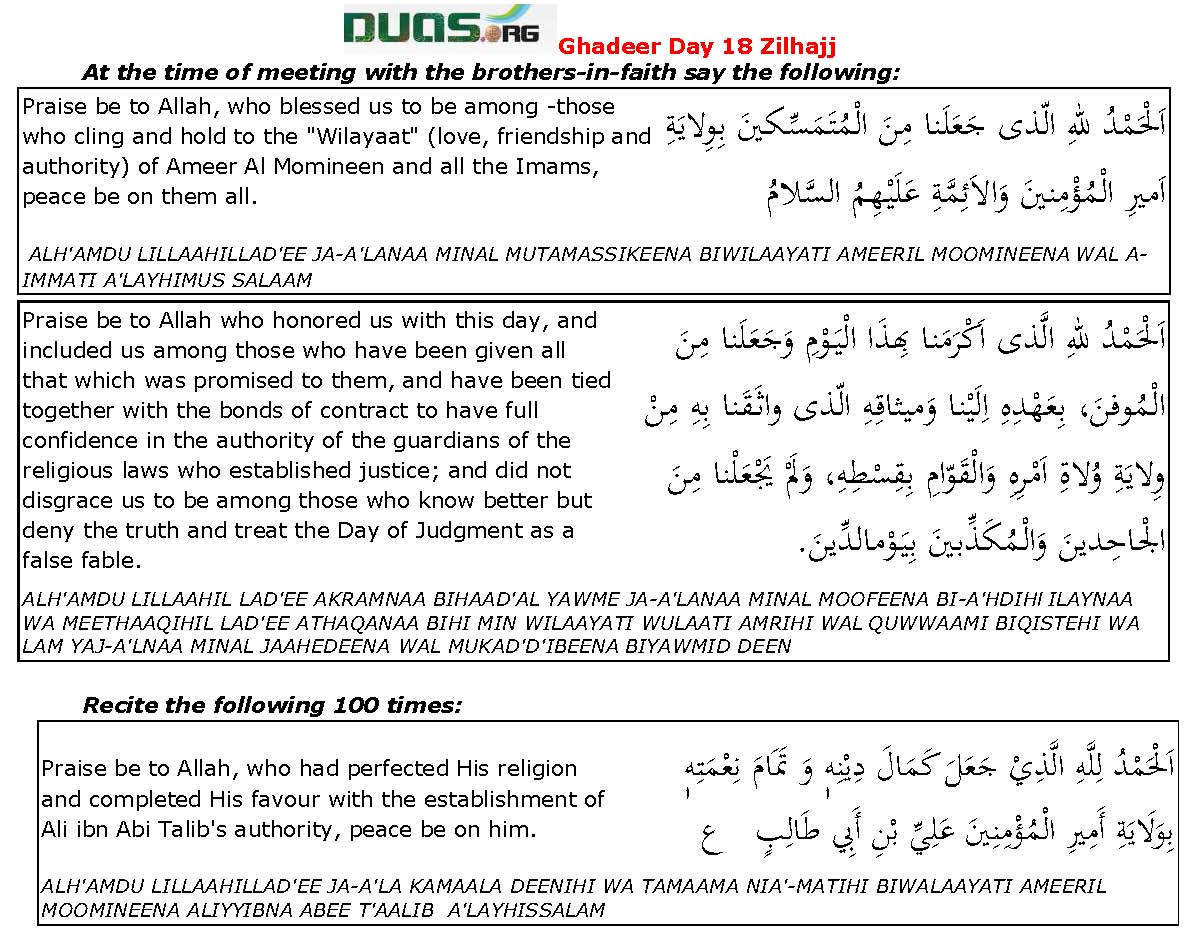
Ninth: It is recommended to congratulate the brethren-in-faith on this day by saying, PDF Jpg
|
اَلْحَمْدُ لِلَّهِ ٱلَّذِي جَعَلَنَا مِنَ ٱلْمُتَمَسِّكِينَ |
alhamdu lill¡hi alladh¢ ja`alan¡ min almutamassik¢na |
Praise be to Allah Who has blessed us to be among those who cling and hold |
|
بِوِلاَيَةِ مِيرِ ٱلْمُؤْمِنِينَ وَٱلئِمَّةِ عَلَيْهِمُ ٱلسَّلاَمُ |
biwil¡yati am¢ri almu'min¢na wal'a'immati `alayhim alssal¡mu |
to the divinely commissioned leadership and authority of Amir al- Mu'mineen and all the Imams, peace be upon them all. |
It is also recommended to say the following:
|
اَلْحَمْدُ لِلَّهِ ٱلَّذِي كْرَمَنَا بِهٰذَا ٱلْيَوْمِ |
alhamdu lill¡hi alladh¢ akraman¡ bih¡dh¡ alyawmi |
All praise be to Allah Who has honored us with this day |
|
وَجَعَلَنَا مِنَ ٱلْمُوفِينَ بِعَهْدِهِ إِلَيْنَا |
wa ja`alan¡ min alm£f¢na bi`ahdih¢ ilayn¡ |
and included us with those who have fulfilled their promise to Him |
|
وَميثَاقِهِ ٱلَّذِي وَاثَقَنَا بِهِ |
wa m¢th¡qih¢ alladh¢ w¡thaqan¡ bih¢ |
and their covenant made with Him; |
|
مِنْ وِلاَيَةِ وُلاَةِ مْرِهِ |
min wil¡yati wul¡ti amrih¢ |
that is the loyalty to His representatives |
|
وَٱلْقَوَّامِ بِقِسْطِهِ |
walquww¡mi biqis§ih¢ |
and the establishers of His justice. |
|
وَلَمْ يَجْعَلْنَا مِنَ ٱلْجَاحِدينَ |
wa lam yaj`aln¡ min alj¡hid¢na |
He has not made us of the deniers |
|
وَٱلْمُكَذِّبينَ بِيَوْمِ ٱلدِّينَ |
walmukadhdhib¢na biyawmi aldd¢ni |
and rejecters of the Judgment Day. |
Tenth: It is recommended to repeat this doxology one hundred times:
|
اَلْحَمْدُ لِلَّهِ ٱلَّذِي جَعَلَ كَمَالَ دِينِهِ |
alhamdu lill¡hi alladh¢ ja`ala kam¡la d¢nih¢ |
All praise be to Allah Who has made the perfection of His religion |
|
وَتَمَامَ نِعْمَتِهِ |
wa tam¡ma ni`matih¢ |
and the completion of His grace |
|
بِوِلاَيَةِ مِيرِ ٱلْمُؤمِنِينَ |
biwil¡yati am¢ri almu'min¢na |
in the leadership of the Commander of the Believers, |
|
عَلِيِّ بْنِ بِي طَالِبٍ عَلَيْهِ ٱلسَّلاَمُ |
`aliyyi bni ab¢ §¡libin `alayhi alssal¡mu |
`Al¢ the son of Abu talib, peace be upon him. |
It is worth mentioning that a great reward has been narrated to be the share of one who, on this day, puts on the best dress, adorns himself, imparts a sweet smell, shows delight and happiness, gives pleasure to the adherents of Imam `Al¢ Am¢r al-Mu'min¢n (`a), pardons them, settles their needs, visits the relatives, confers upon the family members with gifts and whatever they need, offers food to the believers and the observers of fasting, shakes hands with, visits, smiles in the faces of, and presents gifts to the believers, thanks Almighty Allah for the grand bliss of recognizing the Divinely commissioned leadership of Imam `Al¢ (`a), invokes blessings upon the Holy Prophet and his Household, and practices acts of worship and obedience to Almighty Allah. One dirham that is given as alms on this day to a believer is equal to one thousand dirhams that are given on other days. Finally, to offer food to a believer on this day is equal, in reward, to offering food to all the prophets and the veracious people.
Addressing a sermon on the `«d al-Ghad¢r Day, Imam `Al¢ (`a) said, “The reward of offering food to an observant of fasting on this day is equal to the reward of offering food to two hundred thousand prophets, veracious people, and martyrs multiplied by ten. As for one who provides for a number of believing men and women, I guarantee that Almighty Allah will secure him against atheism, poverty ...etc.”
To sum it up, the merit of the `«d al-Ghad¢r Day is too great to be cited. On this day, the deeds of the Sh¢`ah are admitted and their grievances are relieved. On this day, Prophet Moses (`a) overcame the sorcerers, the fire in which Prophet Abraham (`a) was thrown was made by Almighty Allah comfort and peace, Prophet Moses (`a) appointed Yushua ibn N£n as his successor, Prophet Solomon (`a) declared openly before his people that ª¥if ibn Barkhiy¡ would be his successor, and the Holy Prophet Muhammad (`a) united as brothers his companions; therefore, the believers are advised to form brotherhood with each other on this day. This fraternization, as is quoted by Shaykh al-N£r¢ in Mustadrak al-Was¡'il from the book of Z¡d al-Firdaws, can be practiced by putting the right hand on the brother-in-faith’s right had and saying the following:
|
آخَيْتُكَ فِي ٱللَّهِ |
¡khaytuka fill¡hi |
I declare my brotherhood with you for the sake of Allah, |
|
وَصَافَيْتُكَ فِي ٱللَّهِ |
wa ¥¡faytuka fill¡hi |
I establish friendly terms with you for the sake of Allah, |
|
وَصَافَحْتُكَ فِي ٱللَّهِ |
wa ¥¡fahtuka fill¡hi |
I shake hands with you for the sake of Allah, |
|
وَعَاهَدْتُ ٱللَّهَ وَمَلاَئِكَتَهُ |
wa `¡hadtu all¡ha wa mal¡'ikatah£ |
I promise Allah, His angels, |
|
وَكُتُبَهُ وَرُسُلَهُ |
wa kutubah£ wa rusulah£ |
His Books, His Messengers, |
|
وَنْبِيَاءَهُ وَٱلئِمَّةَ ٱلْمَعْصُومِينَ |
wa anbiy¡'ah£ wala'immata alma`¥£m¢na |
His Prophets, and the Infallible Imams, |
|
عَلَيْهِمُ ٱلسَّلاَمُ |
`alayhim alssal¡mu |
peace be upon them, |
|
عَلَىٰ نِّي إِنْ كُنْتُ مِنْ هْلِ ٱلْجَنَّةِ وَٱلشَّفَاعَةِ |
`al¡ ann¢ in kuntu min ahli aljannati walshshaf¡`ati |
that if I will be an inhabitant of Paradise, allowed to intercede for others, |
|
وَاذِنَ لِي بِنْ دْخُلَ ٱلْجَنَّةَ |
wa udhina l¢ bi'an adkhula aljannata |
and if I will be allowed Paradise, |
|
لاَ دْخُلُهَا إِلاَّ وَنْتَ مَعِي |
l¡ adkhuluh¡ ill¡ wa anta ma`¢ |
I will not enter it unless you accompany me therein. |
The other party should then agree by saying,
|
I agree. |
qabilt(u) |
قَبِلْتُ |
Then, the first party says,
|
I thus release you from all the duties of fraternity |
asqa§tu `anka jam¢`a huq£qi al'ukhuwwati |
سْقَطْتُ عَنْكَ جَمِيعَ حُقُوقِ ٱلاخُوَّةِ |
|
except intercession, supplication, and visiting the tombs of the Infallibles. |
m¡ khal¡ alshshaf¡`ata walddu`¡'a walzziy¡rata |
مَا خَلاَ ٱلشَّفَاعَةَ وَٱلدُّعَاءَ وَٱلزِّيَارَةَ |
Similar to this form, al-Muhaddith al-Fay¤, in his book of Khul¡¥at al-Adhk¡r, has mentioned a form of fraternization adding that the other party, or his representative, may accept the fraternization by uttering any statement entailing agreement. Then, each party releases the other from the duties of fraternity except supplication and visiting the tombs of the Infallibles.
|
Dua after 2 rakat Prayer before zuhr -"Rabana Inna Samena..." Pdf Recite 2 Rakat Salaat-(30 minutes before noon) In every Raka't, after the recitation of Surah Al Fatih'ah once, recite: (i) Soorah Al Ikhlaas 10 times.+ (ii) Aayaat ul Kursee 10 times. +(iii) Soorah At Qadr. 10 times. |
|
|
"Our Lord! we have heard the call of one calling (Us) to Faith, 'Believe ye in the Lord,' and we have believed. Our Lord! Forgive us our sins,blot out from us our iniquities, and take to Yourself our souls in the company of the righteous. Our Lord! Grant us what You didst promise unto us through Your apostles, and save us from shame on the Day of Judgment: For You never breakest Your promise. " Al-i-Imran 3:193-194 O' my God! I take You as witness. You suffice as a witness for me. I take Your angels, the carriers of Your Throne, the controllers of your heavens and earth as witnesses that You are God and there are no Gods but you. you are the one besides whose Noble Face none is worshipped! There is no God but You! O' He who is Worshipped and there is no one else to worship but you. you are Sublime and You are high indeed are You exalted above what the evil-doers say! "Exalted and Great (beyond measure)" . Al-Isra 17:43. Bear witness that Muhammad (MGB) is Your Servant and Your Prophet. I bear witness that Ali is the Commander of the Faithful. He is their friend, and master and he is my master. O' our Lord! We heard the call and acknowledge the caller who is Your Prophet (MGB). He called based on Your Order and declared the mastery of the Commander of the Faithful about which You had admonished him that You would be angry with him if he does not deliver this message, and that You will protect him from the people if he does. So he delivered this message and declared, "Whoever I am the Master of, Ali is the Master of. Whoever I am the Guardian of, Ali is the Guardian of Whoever I am the Prophet of, Ali is the Commander of" O' our Lord! We positively respond to the call of Muhammad - the conveyor of good tidings, the warner, Your servant whom You blessed, and established as an example for the Children of Israel. O' our Lord! We believe and follow our master, our guardian, our guide, the one who invites us and invites the people, and in Your Straight Path, Your bright Path through which he and his followers call us to You. " ... Exalted is Allah far above the things they associate with Him/" Al-Tur 52:43. Some doubt his Mastery and Order of their Lord by finding associates other than him. O' my God! Please bear witness that Ali ibn Abi Talib (MGB) is the Divine Leader - the guide, the guider and the guided about whom You said the following in Your Book, "And verily, it is in the Mother of the Book, in Our Presence, high (in dignity),full ofwisdom."2 Al-Zukhruf 43:4. O' my God! We bear witness that he is Your Guiding Servant after Your Prophet - the conveyor of good tidings, the warner, the right path and the Divine Leader of the believers, leader of those with white-foreheads (those who are proud of their deeds. Some have interpreted this to refer to those whose hands, feet and foreheads are white due to extended prostrations ) Your Clear Proof, Your Speaking Tongue to the people on Your Behalf, one standing firm on justice after Your Prophet who propagates Your Religion, the Treasure of Your Knowledge, the seat of Your Revelations, Your Servant, Your Trusted One, who has made a covenant when You took covenant from Your Messengers witnessing to and sincere in his belief of Your Oneness. For You are God .. There is no God but You. Muhammad is Your Servant and Prophet. And Ali is the Commander of the Faithful. You established confessing to His Mastery as the perfection of belief in Your Oneness and sincerity for you and the completion of Your Religion and the perfection of Your Blessings for all Your creatures. You said the following and whatever you say is right. "This day have I perfected your religion for you, completed My Favor upon you, and have chosen for you Islam as your religion. "1 Praise belongs to You for Your Favor upon us in sincere utterance of Your Oneness, and the Mastery of Your Friend upon us after Your Prophet - the one who gives good tidings, the one who warns. You were pleased with Islam as our Religion due to our master, and perfected Your Blessings with the renewal of Your Promise and Covenant, and its reminder. Let us be amongst the sincere ones who acknowledge Your Promise and Covenant, who adhere to this and do not let us be amongst the deserters and those who refute the Day of Judgment. Do not place us amongst those who change and manipulate things, who cut the ears of the animals, change God's Creation who have been overcome by Satan, have forgotten God's Remembrance and have deviated from the Right Path." Say the following often, "O' my God! Please damn those who deny God, the deserters, the ones who change, the liars and those who refute - those who lie about the Resurrection Day from the first and the last generations." Then say, "O' my God! Praise belongs to You over Your Blessings to us thatwhich You guided us towards friendship with those in charge of Your Affairs after Your Prophet, and the guiding Divine Leaders whom You established as the pillars of the profession of Your Unity, signs of true guidance, pillars of virtue, the most trustworthy strong-hold,s the perfection of Your Religion, the completion of Your Blessings, those by whom and through whose Mastery You chose Islam as our religion. 0' our Lord! Praise belongs to You. We believe in You and we certify Your Prophet - the Messenger, the one who gives good tidings, the one who warns. We follow the guides after the one who gives good tidings, the one who warns. We shall be friends with their friends and enemy of their enemies. Please separate us from those who deny God, the deserters and those who refute the Day of the Judgment. 0' my God! O' Truthful in promise!0 He who never breaks His Promise 0' He who shines in splendor every day It was you who completed Your Blessings for us by the Mastery of your Friends - those to whom Your Servants are responsible, since You have said "Then shall ye be questioned that Day about the joy (ye indulged in!). Al-Takathur I 02:8.and said, 'But stop them, for they must be asked·"2 As-Saffat 37:24. You Favored with sincere testimony to the Mastery of Your Friends who are the ones who give good tidings, the ones who warn, and the luminous lanterns. You perfected the blessings for us by their Mastery and disowning their enemies. You perfected the Blessings for us by renewing their Covenant and by reminding us of our testimony in the beginning of Creation. Your let us be of those who answer in the positive, and reminded us about our promise and covenant, and did not let us forget it and said, "When Your Lord drew forth from the Children of Adam - from their loins - their descendants, and made them testify concerning themselves, (saying): ''Am I not your Lord (who cherishes and sustains you)?"They said· "Yea! We do testify!',3 Al-A'raf7:172 We bear witness to Your Favor that You are God. There are no Gods but You. You are our Lord and Your Servant and Prophet Muhammad (MGB) is our Prophet. We bear witness that the Commander of the Faithful Ali (MGB) is our Guardian and Master. We bear witness to the Mastery of our Master and our Guardian from the progeny of Your Prophet, and from the lineage of our Master - the Commander of the Faithful Ali ibn Abi Talib (MGB) - who is Your Servant whom You blessed! You established him as Knowing and Wise in the Mother of the Book that is near You and established him as a sign for Your Prophet and as one of the main signs. He is the great news about whom many people had differences. He is that great news from which they turned their faces away and about which they shall be questioned on the Resurrection Day. He is the Perfection of Your Blessings for whom Your Servants shall be stopped and questioned. 0' my God! As You honored us with the blessing of being guided to their recognition, please honor us and bestow Your Blessings on Muhammad and his Progeny, bless us on this day in which You reminded us of Your promise and Your Covenant! Please complete our religion and perfect Your Blessings for us. Please let us be amongst those whose prayers are answered and are sincere in their belief to your Oneness, and those with true faith, acknowledging the Mastery of Your Friends, and disowning Your enemies, the enemies of Your Friends, those who deny God and those who refute the Day of the Judgment. O' Lord! I ask You for the perfection of the Blessings which You have granted us. Please do not let us be amongst those who oppose and do not let us join those who refute the Day of the Judgment. Please let us take a true step along with the virtuous ones. Please grant us mercy from Your own Presence; and let us have a leader from the pious people until the Judgment Day - the day on which all the people are called along with their leaders. And place us in the shade of the pious people - the guides after the conveyor of good tidings, the warner's, the Divine Leaders who invite to guidance. Please do not let us be amongst the liars who invite towards the Fire and are disgraced along with their friends on the Resurrection Day. O' our Lord! Please resurrect us amongst those who are guided and resurrect us when You do so faithfulness to Your Pledge and the Covenant taken from us regarding friendship with Your Trustees, and disowning from Your enemies who refute the Day of Judgment, and the deserters of Your Covenant, and let us die in this way. Please keep us on the path of the Messenger and please firmly establish our true steps in immigration to them. Please let our lives be the best lives and let our deaths be the best deaths and let our transformations be the best transformation s- in love for Your Friends and disowning from Your Enemies until You take away our lives with You pleased with us: And make our entry into Paradise a sure thing out of Your Mercy, and let us reside by You and turn to the House of Permanence out of Your Nobility! without and hardship or strenuous efforts theirs. O' Our Lord , You ordered us to obey him and obey those in charge of Your Affairs. You ordered us and said, "Obey Allah, and obey the Messenger, and those charged with authority among you. "1 Al-Nisa 4:59 You also said, "O' ye who believe! Fear Allah and be with those who are true (in word and deed). ,,2 Al-Tauba 9:119 Our Lord We hear and obey. Our Lord! Please firmly establish our steps and take to Yourself our souls in the company of the righteous as true Muslims who acknowledge Your Friends. "Our Lord!" (they say), "Let not our hearts deviate now after You have guided us, but grant us mercy from Your own Presence; for You are the Grantor of bounties without measure. "1 : Al-i-Imran 3:8 O' our Lord! We believe in You and we acknowledge Your Prophet: Your Friend and those after Your Prophet are our Guardians. And Your Friend is the master of the believers Ali ibn Abi Talib (MGB) - the Divine Leader - the guide after the Prophet - the conveyor of good tidings the warner, and the luminous lantern. O' our Lord! You have let us be faithful to Your Pledge by Your Favor and Kindness to us. So please "Our Lord! Forgive us our sins, blot out from us our iniquities, and take to Yourself our souls in the company of the righteous. Our Lord! Grant us what You didst promise unto us through Your apostles, and save us from shame on the Day of Judgment: For You never breakest Your promise. Al-i-Imran 3: 193-194 O' our Lord! We believe in You, we are loyal to Your pledge and we acknowledge Your Prophet. We follow those in charge of the affairs after Your Prophet, we shall be friends with Your Friends and we shall oppose Your enemies. Please then write us down amongst those who bear witness. And resurrect us along with the Leaders to Guidance from the Progeny of Prophet Muhammad - the conveyor of good tidings, the warner. O' Lord! We believe in them private or public, present or absent, living or dead! We are pleased with them as our Divine Leaders and Masters. We shall never seek anyone but them, and shall not take any confidants but them. O' our Lord! Please let us live with their love, disowning their enemies, and submission to and obedience to them. Please let us die in a state of loyalty to them in promise and covenant for You, love for them, certifying and submitting to them - not those who deny God, the deserters and those who refute. O' my God! I ask You by the right that You put near them, and made them superior to all the people of the world. Please bless us on this day in which You honored us by acting upon Your Promise and the Covenant to love Your Friends. And favor us by granting us Your Bounties. Please make it a place of sojourn for us, and never take it away and do not let it be a place of departure for us as you said,"here is a place of sojourn and a place of departure. ,,3 Al-An'am 6:98. And let it be firmly established. O' God! Please bless use with the victory of Your Religion with the guide from the Progeny of Your Prophet who shall rise to direct us out of deviation. Please put us under his flag and include us amongst the true martyrs killed in Your Path and in aiding Your Religion." |
رَبَّنا إِنَّنا سَمِعْنا مُنادِياً يُنادِي لِلْإِيمانِ أَنْ آمِنُوا بِرَبِّكُمْ فَآمَنَّا رَبَّنا فَاغْفِرْ لَنا ذُنُوبَنا وَ كَفِّرْ عَنَّا سَيِّئاتِنا وَ تَوَفَّنا مَعَ الْأَبْرارِ رَبَّنا وَ آتِنا ما وَعَدْتَنا عَلى رُسُلِكَ وَ لا تُخْزِنا يَوْمَ الْقِيامَةِ إِنَّكَ لا تُخْلِفُ الْمِيعادَ) اللَّهُمَّ إِنِّي أُشْهِدُكَ وَ كَفَى بِكَ شَهِيداً وَ أُشْهِدُ مَلَائِكَتَكَ وَ أَنْبِيَاءَكَ وَ حَمَلَةَ عَرْشِكَ وَ سُكَّانَ سَمَاوَاتِكَ وَ أَرْضِكَ بِأَنَّكَ أَنْتَ اللَّهُ لَا إِلَهَ إِلَّا أَنْتَ الْمَعْبُودُ فَلَا نَعْبُدُ سِوَاكَ فَتَعَالَيْتَ عَمَّا يَقُولُ الظَّالِمُونَ عُلُوّاً كَبِيراً وَ أَشْهَدُ أَنَّ مُحَمَّداً عَبْدُكَ وَ رَسُولُكَ وَ أَشْهَدُ أَنَّ أَمِيرَ الْمُؤْمِنِينَ عَبْدُكَ وَ مَوْلَانَا رَبَّنَا سَمِعْنَا وَ أَجَبْنَا وَ صَدَّقْنَا الْمُنَادِيَ رَسُولَكَ صَلَّى اللَّهُ عَلَيْهِ وَ آلِهِ إِذْ نَادَى بِنِدَاءٍ عَنْكَ بِالَّذِي أَمَرْتَهُ أَنْ يُبَلِّغَ مَا أَنْزَلْتَ إِلَيْهِ مِنْ وَلَايَةِ وَلِيِّ أَمْرِكَ وَ حَذَّرْتَهُ وَ أَنْذَرْتَهُ إِنْ لَمْ يُبَلِّغْ مَا أَمَرْتَهُ أَنْ تَسْخَطَ عَلَيْهِ وَ لَمَّا بَلَّغَ رِسَالاتِكَ عَصَمْتَهُ مِنَ النَّاسِ فَنَادَى مُبَلِّغاً عَنْكَ أَلَا مَنْ كُنْتُ مَوْلَاهُ فَعَلِيٌّ مَوْلَاهُ وَ مَنْ كُنْتُ وَلِيَّهُ فَعَلِيٌّ وَلِيُّهُ وَ مَنْ كُنْتُ نَبِيَّهُ فَعَلِيٌّ أَمِيرُهُ رَبَّنَا قَدْ أَجَبْنَا دَاعِيَكَ النَّذِيرَ مُحَمَّداً عَبْدَكَ وَ رَسُولَكَ إِلَى الْهَادِي الْمَهْدِيِّ عَبْدِكَ الَّذِي أَنْعَمْتَ عَلَيْهِ وَ جَعَلْتَهُ (مَثَلًا لِبَنِي إِسْرائِيلَ) عَلِيٍّ أَمِيرِ الْمُؤْمِنِينَ وَ مَوْلَاهُمْ وَ وَلِيِّهِمْ رَبَّنَا وَ اتَّبَعْنَا مَوْلَانَا وَ وَلِيَّنَا وَ هَادِيَنَا وَ دَاعِيَنَا وَ دَاعِيَ الْأَنَامِ وَ صِرَاطَكَ الْمُسْتَقِيمَ وَ حُجَّتَكَ الْبَيْضَاءَ وَ سَبِيلَكَ الدَّاعِيَ إِلَيْكَ عَلَى بَصِيرَةٍ هُوَ وَ مَنِ اتَّبَعَهُ وَ سُبْحانَ اللَّهِ عَمَّا يُشْرِكُونَ وَ أَشْهَدَ أَنَّهُ الْإِمَامُ الْهَادِي الْمَهْدِيُّ الرَّشِيدُ- أَمِيرُ الْمُؤْمِنِينَ الَّذِي ذَكَرْتَهُ فِي كِتَابِكَ وَ أَنَّكَ قُلْتَ (وَ إِنَّهُ فِي أُمِّ الْكِتابِ لَدَيْنا لَعَلِيٌّ حَكِيمٌ) اللَّهُمَّ فَإِنَّا نَشْهَدُ بِأَنَّهُ عَبْدُكَ وَ الْهَادِي مِنْ بَعْدِ نَبِيِّكَ النَّذِيرِ الْمُنْذِرِ وَ صِرَاطُكَ الْمُسْتَقِيمُ وَ أَمِيرُ الْمُؤْمِنِينَ وَ قَائِدُ الْغُرِّ الْمُحَجَّلِينَ وَ حُجَّتُكَ الْبَالِغَةُ وَ لِسَانُكَ الْمُعَبِّرُ عَنْكَ فِي خَلْقِكَ وَ أَنَّهُ الْقَائِمُ بِالْقِسْطِ فِي بَرِيَّتِكَ وَ دَيَّانُ دِينِكَ وَ خَازِنُ عِلْمِكَ وَ أَمِينُكَ الْمَأْمُونُ الْمَأْخُوذُ مِيثَاقُهُ وَ مِيثَاقُ رَسُولِكَ عَلَيْهِمَا السَّلَامُ مِنْ جَمِيعِ خَلْقِكَ وَ بَرِيَّتِكَ شَاهِداً بِالْإِخْلَاصِ لَكَ وَ الْوَحْدَانِيَّةِ وَ الرُّبُوبِيَّةِ بِأَنَّكَ أَنْتَ اللَّهُ لَا إِلَهَ إِلَّا أَنْتَ وَ أَنَّ مُحَمَّداً عَبْدُكَ وَ رَسُولُكَ وَ أَنَّ عَلِيّاً أَمِيرُ الْمُؤْمِنِينَ جَعَلْتَهُ وَ الْإِقْرَارَ بِوَلَايَتِهِ تَمَامَ وَحْدَانِيَّتَكَ وَ كَمَالَ دِينِكَ وَ تَمَامَ نِعْمَتِكَ عَلَى جَمِيعِ خَلْقِكَ وَ بَرِيَّتِكَ فَقُلْتَ وَ قَوْلُكَ الْحَقُ (الْيَوْمَ أَكْمَلْتُ لَكُمْ دِينَكُمْ وَ أَتْمَمْتُ عَلَيْكُمْ نِعْمَتِي وَ رَضِيتُ لَكُمُ الْإِسْلامَ دِيناً) فَلَكَ الْحَمْدُ بِمُوَالاتِهِ وَ إِتْمَامِ نِعْمَتِكَ عَلَيْنَا بِالَّذِي جَدَّدْتَ مِنْ عَهْدِكَ وَ مِيثَاقِكَ ذَكَّرْتَنَا ذَلِكَ وَ جَعَلْتَنَا مِنْ أَهْلِ الْإِخْلَاصِ وَ التَّصْدِيقِ بِمِيثَاقِكَ وَ مِنْ أَهْلِ الْوَفَاءِ بِذَلِكَ وَ لَمْ تَجْعَلْنَا مِنْ أَتْبَاعِ الْمُغَيِّرِينَ وَ الْمُبَدِّلِينَ وَ الْمُنْحَرِفِينَ وَ الْمُبَتِّكِينَ آذَانَ الْأَنْعَامِ وَ الْمُغَيِّرِينَ خَلْقَ اللَّهِ وَ مِنَ الَّذِينَ (اسْتَحْوَذَ عَلَيْهِمُ الشَّيْطانُ فَأَنْساهُمْ ذِكْرَ اللَّهِ)وَ صَدَّهُمْ عَنِ السَّبِيلِ وَ الصِّرَاطِ الْمُسْتَقِيمِ اللَّهُمَّ الْعَنِ الْجَاحِدِينَ وَ النَّاكِثِينَ وَ الْمُغَيِّرِينَ وَ الْمُكَذِّبِينَ بِيَوْمِ الدِّينِ مِنَ الْأَوَّلِينَ وَ الْآخِرِينَ اللَّهُمَّ فَلَكَ الْحَمْدُ عَلَى إِنْعَامِكَ عَلَيْنَا بِالْهُدَى الَّذِي هَدَيْتَنَا بِهِ إِلَى وُلَاةِ أَمْرِكَ مِنْ بَعْدِ نَبِيِّكَ الْأَئِمَّةِ الْهُدَاةِ الرَّاشِدِينَ وَ أَعْلَامِ الْهُدَى وَ مَنَارِ الْقُلُوبِ وَ التَّقْوَى وَ الْعُرْوَةِ الْوُثْقَى وَ كَمَالِ دِينِكَ وَ تَمَامِ نِعْمَتِكَ وَ مَنْ بِهِمْ وَ بِمُوَالاتِهِمْ رَضِيتَ لَنَا الْإِسْلَامَ دِيناً رَبَّنَا فَلَكَ الْحَمْدُ آمَنَّاً وَ صَدَّقْنَا بِمَنِّكَ عَلَيْنَا- بِالرَّسُولِ النَّذِيرِ الْمُنْذِرِ وَالَيْنَا وَلِيَّهُمْ وَ عَادَيْنَا عَدُوَّهُمْ وَ بَرِئْنَا مِنَ الْجَاحِدِينَ وَ الْمُكَذِّبِينَ بِيَوْمِ الدِّينِ اللَّهُمَّ فَكَمَا كَانَ ذَلِكَ مِنْ شَأْنِكَ يَا صَادِقَ الْوَعْدِ يَا مَنْ (لا يُخْلِفُ الْمِيعادَ) يَا مَنْ هُوَ كُلَّ يَوْمٍ فِي شَأْنٍ إِذْ أَتْمَمْتَ عَلَيْنَا نِعْمَتَكَ بِمُوَالاةِ أَوْلِيَائِكَ الْمَسْئُولِ عَنْهُمْ عِبَادُكَ فَإِنَّكَ قُلْتَ (ثُمَّ لَتُسْئَلُنَّ يَوْمَئِذٍ عَنِ النَّعِيمِ)وَ قُلْتَ وَ قَوْلُكَ الْحَقُ (وَ قِفُوهُمْ إِنَّهُمْ مَسْؤُلُونَ) وَ مَنَنْتَ عَلَيْنَا بِشَهَادَةِ الْإِخْلَاصِ وَ بِوَلَايَةِ أَوْلِيَائِكَ الْهُدَاةِ بَعْدَ النَّذِيرِ الْمُنْذِرِ السِّرَاجِ الْمُنِيرِ وَ أَكْمَلْتَ لَنَا بِهِمُ الدِّينَ وَ أَتْمَمْتَ عَلَيْنَا النِّعْمَةَ وَ جَدَّدْتَ لَنَا عَهْدَكَ وَ ذَكَّرْتَنَا مِيثَاقَكَ الْمَأْخُوذَ مِنَّا فِي ابْتِدَاءِ خَلْقِكَ إِيَّانَا وَ جَعَلْتَنَا مِنْ أَهْلِ الْإِجَابَةِ وَ لَمْ تُنْسِنَا ذِكْرَكَ فَإِنَّكَ قُلْتَ (وَ إِذْ أَخَذَ رَبُّكَ مِنْ بَنِي آدَمَ مِنْ ظُهُورِهِمْ ذُرِّيَّتَهُمْ وَ أَشْهَدَهُمْ عَلى أَنْفُسِهِمْ أَ لَسْتُ بِرَبِّكُمْ قالُوا بَلى) شَهِدْنَا بِمَنِّكَ وَ لُطْفِكَ بِأَنَّكَ أَنْتَ اللَّهُ لَا إِلَهَ إِلَّا أَنْتَ رَبُّنَا وَ مُحَمَّدٌ عَبْدُكَ وَ رَسُولُكَ نَبِيُّنَا وَ عَلِيٌّ أَمِيرُ الْمُؤْمِنِينَ عَبْدُكَ الَّذِي أَنْعَمْتَ بِهِ عَلَيْنَا وَ جَعَلْتَهُ آيَةً لِنَبِيِّكَ عَلَيْهِ السَّلَامُ وَ آيَتَكَ الْكُبْرَى وَ النَّبَأَ الْعَظِيمَ- (الَّذِي هُمْ فِيهِ مُخْتَلِفُونَ) وَ عَنْهُ مَسْئُولُونَ اللَّهُمَّ فَكَمَا كَانَ مِنْ شَأْنِكَ أَنْ أَنْعَمْتَ عَلَيْنَا بِالْهِدَايَةِ إِلَى مَعْرِفَتِهِمْ فَلْيَكُنْ مِنْ شَأْنِكَ أَنْ تُصَلِّيَ عَلَى مُحَمَّدٍ وَ آلِ مُحَمَّدٍ وَ أَنْ تُبَارِكَ لَنَا فِي يَوْمِنَا هَذَا الَّذِي أَكْرَمْتَنَا بِهِ وَ ذَكَّرْتَنَا فِيهِ عَهْدَكَ وَ مِيثَاقَكَ وَ أَكْمَلْتَ دِينَنَا وَ أَتْمَمْتَ عَلَيْنَا نِعْمَتَكَ وَ جَعَلْتَنَا بِمَنِّكَ مِنْ أَهْلِ الْإِجَابَةِ وَ الْبَرَاءَةِ مِنْ أَعْدَائِكَ وَ أَعْدَاءِ أَوْلِيَائِكَ الْمُكَذِّبِينَ بِيَوْمِ الدِّينِ فَأَسْأَلُكَ يَا رَبِّ تَمَامَ مَا أَنْعَمْتَ وَ أَنْ تَجْعَلَنَا مِنَ الْمُوفِينَ وَ لَا تُلْحِقَنَا بِالْمُكَذِّبِينَ وَ اجْعَلْ لَنَا قَدَمَ صِدْقٍ مَعَ الْمُتَّقِينَ- وَ اجْعَلْ لَنَا مِنَ الْمُتَّقِينَ إِمَاماً يَوْمَ تَدْعُو (كُلَّ أُناسٍ بِإِمامِهِمْ) وَ احْشُرْنَا فِي زُمْرَةِ أَهْلِ بَيْتِ نَبِيِّكَ الْأَئِمَّةِ الصَّادِقِينَ وَ اجْعَلْنَا مِنَ الْبُرَآءِ مِنَ الَّذِينَ هُمْ دُعَاةٌ إِلَى النَّارِ- (وَ يَوْمَ الْقِيامَةِ هُمْ مِنَ الْمَقْبُوحِينَ) وَ أَحْيِنَا عَلَى ذَلِكَ مَا أَحْيَيْتَنَا وَ اجْعَلْ لَنَا (مَعَ الرَّسُولِ سَبِيلًا) وَ اجْعَلْ لَنَا قَدَمَ صِدْقٍ فِي الْهِجْرَةِ إِلَيْهِمْ وَ اجْعَلْ مَحْيَانَا خَيْرَ الْمَحْيَا وَ مَمَاتَنَا خَيْرَ الْمَمَاتِ وَ مُنْقَلَبَنَا خَيْرَ الْمُنْقَلَبِ عَلَى مُوَالاةِ أَوْلِيَائِكَ وَ مُعَادَاةِ أَعْدَائِكَ حَتَّى تَوَفَّانَا وَ أَنْتَ عَنَّا رَاضٍ قَدْ أَوْجَبْتَ لَنَا جَنَّتَكَ بِرَحْمَتِكَ وَ الْمَثْوَى مِنْ جِوَارِكَ فِي دَارِ الْمُقَامَةِ مِنْ فَضْلِكَ- (لا يَمَسُّنا فِيها نَصَبٌ وَ لا يَمَسُّنا فِيها لُغُوبٌ) (رَبَّنَا اغْفِرْ لَنا ذُنُوبَنا وَ كَفِّرْ عَنَّا سَيِّئاتِنا وَ تَوَفَّنا مَعَ الْأَبْرارِ رَبَّنا وَ آتِنا ما وَعَدْتَنا عَلى رُسُلِكَ وَ لا تُخْزِنا يَوْمَ الْقِيامَةِ إِنَّكَ لا تُخْلِفُ الْمِيعادَ) اللَّهُمَّ وَ احْشُرْنَا مَعَ الْأَئِمَّةِ الْهُدَاةِ مِنْ آلِ رَسُولِكَ نُؤْمِنُ بِسِرِّهِمْ وَ عَلَانِيَتِهِمْ وَ شَاهِدِهِمْ وَ غَائِبِهِمْ اللَّهُمَّ إِنِّي أَسْأَلُكَ بِالْحَقِّ الَّذِي جَعَلْتَهُ عِنْدَهُمْ وَ بِالَّذِي فَضَّلْتَهُمْ بِهِ عَلَى الْعَالَمِينَ جَمِيعاً أَنْ تُبَارِكَ لَنَا فِي يَوْمِنَا هَذَا الَّذِي أَكْرَمْتَنَا فِيهِ بِالْمُوَافَاةِ بِعَهْدِكَ الَّذِي عَهِدْتَهُ إِلَيْنَا وَ الْمِيثَاقِ الَّذِي وَاثَقْتَنَا بِهِ مِنْ مُوَالاةِ أَوْلِيَائِكَ وَ الْبَرَاءَةِ مِنْ أَعْدَائِكَ أَنْ تُتِمَّ عَلَيْنَا نِعْمَتَكَ وَ لَا تَجْعَلْهُ مُسْتَوْدَعاً وَ اجْعَلْهُ مُسْتَقَرّاً وَ لَا تَسْلُبَنَاهُ أَبَداً وَ لَا تَجْعَلْهُ مُسْتَعَاراً وَ ارْزُقْنَا مُرَافَقَةَ وَلِيِّكَ الْهَادِي الْمَهْدِيِّ إِلَى الْهُدَى وَ تَحْتَ لِوَائِهِ وَ فِي زُمْرَتِهِ شُهَدَاءَ صَادِقِينَ عَلَى بَصِيرَةٍ مِنْ دِينِكَ- إِنَّكَ عَلى كُلِّ شَيْءٍ قَدِير
|
Ghadeer Night Dua after 12 Rakat salat pdf
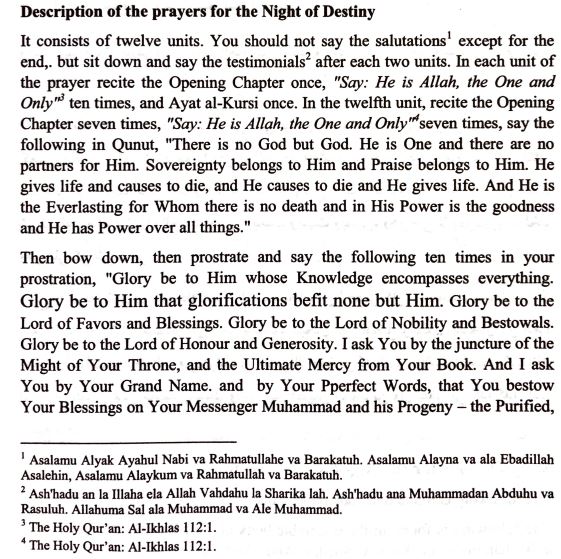
As per book Iqbal Al Aamal ;The night Salat consists of twelve units. You should not say the salutations1 except for the end,. but sit down and say the testimonials2 after each two units. In each unit of the prayer recite the Opening Chapter once, Al-Ikhlas 112
"Say: He is Allah, the One and Only'') ten times, and Ayat al-Kursi once.In the twelfth unit, recite the Opening Chapter seven times, "Say: Al-Ikhlas 112He is Allah, the One and Only,seven times, say the following in Qunut, "There is no God but God. He is One and there are no partners for Him. Sovereignty belongs to Him and Praise belongs to Him. He gives life and causes to die, and He causes to die and He gives life. And He is the Everlasting for Whom there is no death and in His Power is the goodness and He has Power over all things."
Then bow down, then prostrate and say the following ten times in your prostration, "Glory be to Him whose Knowledge encompasses everything.Glory be to Him that glorifications befit none but Him. Glory be to the Lord of Favors and Blessings. Glory be to the Lord of Nobility and Bestowals. Glory be to the Lord of Honour and Generosity. I ask You by the juncture of the Might of Y our Throne, and the Ultimate Mercy from Your Book. And I ask You by Your Grand Name. and by Your Pperfect Words,, that You bestow Your Blessings on Your Messenger Muhammad and his Progeny - the Purified,
1 Asalamu Alyak Ayahul Nabi va Rabmatullahe va Barakatuh. Asalamu Alayna va ala Ebadillah Asalehin, Asalamu Alaykum va Rahmatullah va Barakatuh.
2 Ash'hadu an la Illaha ela Allah Vahdahu la Sharika lab. Ash'hadu ana Muhammadan Abduhu va Rasuluh. Allahuma Sal ala Muhammad va Ale Muhammad.
|
O” my God ! You invited us to the path of obeying You, Your Prophet, his Trustee and his household – an invitation filled with light, illumination, joy and brightness. Then Your Prophet of Mercy invited us to follow his Trustee (Imam Ali) on the Day of Ghadir Khum and You granted us success in choosing the correct path and helped us accept his invitation. Thus we turned back to You and submitted our hearts to Your Prophet, and our souls to his Trustee and our intellects to what You invited us to. O’ Guider of the deviated! Please perfect Your Light for us. Please take away from our hearts, souls and tongues and thoughts any hatred, denial or flattery for Your Trusted One – the Commander of the Faithful Ali, and the father of the rest of the Divine Leaders... Please increase our friendship, love, and affection for him and the Divine Leaders after him such that there is no cessation or end for it. Please let us be enemies of his enemies and friends with his friends with our sole intention of this being Your Obedience. O’ the Most Compassionate, Most Merciful… O’ my God! Please place Your Punishment and Wrath on whoever is the enemy of Your Friend, denies his Divine Leadership, rejects his Mastery whom You have reserved for the periods of sedition in all periods, times and eras as indeed You have Power over all things. O’ my God! I ask You for the sake of Your Prophet Muhammad and Your Friend Ali and Your Proofs – the Divine Leaders after him to establish my heart firmly on Your Religion and the love of Your Friends, and hatred of Your enemies along with the good of this world and the Hereafter for me, my wife, children and Muslim brethren as indeed You have Power over all things…” |
لَّهُمُّ إِنّكَ دَعْوَتَنَا إِلَى سَبِيلِ طَاعَتكَ وَطَاعَةَ نَبِيّكَ وَوَصِيِّهِ وعترته،دُعَاءٌ لَهُ نُورِ وَضِيَاءٍ، وبهجة وَاِسْتَنَارَ، فَدَعَانَا نَبِيُّكَ لِوَصِيِّهِ يَوْمِ غَدِيرِخُمٍّ، فَوَفَّقْتِنَا لِلْإصَابَةِ وَسَدَّدْتِنَا لِلْإِجَابَةِ لِدُعَائِهِ، فَأَنَلْنَا إِلَيكَ بالانابة،وَأسْلمنَا لِنَبِيِّكَ قُلُوبِنَا، وَلِوَصِيِّهِ نُفُوسِنَا، وَلِمَا دَعْوَتُنَا إِلَيْهِ عُقُولَنَا. فَتَمٌّلَنَا نَوَّرَكَ يا هَادَى الْمُضِلِّينَ، اُخْرُجْ الْبُغْضَ وَالْمُنْكِرَ وَالْغُلُوَّ لِأَمينِكَ أَميرالْمُؤْمِنِينَ وَالْأئِمَّةَ مِنْ وَلَدِهِ، مِنْ قُلُوبِنَا وَنُفُوسِنَا وَأَلْسِنَتِنَا، وهمومنا،وَزِدْنَا مِنْ مَوّالَاتِهُ وَمُحِبَّتِهِ وَمَوَدَّتِهِ لَهُ وَالْأئِمَّةُ مِنْ بَعْدهُ زِيَادَاتٌ لَااِنْقِطَاعُ لِهَا، وَمُدَّةٌ لَا تَنَاهَى لَهَا، وَاِجْعَلْنَا نُعَادِي لِوَلِيَكَ مِنْ نَاصِبِهِ،وَنُوَالَى مِنْ أَحَبِّهِ وَنَأْمُلُ بِذَلِكَ طَاعَتَكَ، يا اِرْحَمْ الرَّاحِمِينَ. اللَّهُمُّ اِجْعَلْ عَذَابَكَ وَسُخْطَكَ عَلَى مِنْ نَاصِبِ وَلِيِّكَ وَجُحِدَ إمَامَتُهُ وَأُنْكِرَ وَلَاَيَتُهُ وَقدمتُهُ أيَّامِ فتنتِكَ فِي كُلُّ عَصْرِ وَزَمَانِ واوَانِ، اِنْكِ عَلَى كُلَّ شئقَدِيرٌ. اللَّهُمُّ بِحُقِّ مُحَمَّدِ رَسُولِكَ وَعَلَي وَلِيُّكَ وَالْأئِمَّةُ مِنْ بَعْدهُ حِجَجَكَ، فاثبت قُلَّبِيٌّ عَلَى دِينِكَ، وَمُوالاة أَوْلِيَائِكَ وَمُعَادَاة أَعْدَائِكَ، مَعَ خَيْرِ الدُّنْيَا وَالْآخِرَةِ، تَجَمُّعَه لِي وَلِأهْلَيْ وَوَلَدَيْ وَإِخْوَانَي الْمُؤْمِنِينَ، اِنْكِ عَلَى كُلَّ شئ قَدِير |